Custom drapery in Los Angeles should begin with the room, not with a catalog of curtain styles. The architecture, ceiling height, window proportions, natural light, privacy requirements, furniture placement and way the space is used all influence how the finished drapery should be designed.
House of Drapery by Duroque provides custom drapery for Los Angeles residences, designers and trade projects under designer supervision. We oversee the process from consultation, measuring and specification through fabric selection, fabrication, hardware, installation and final steaming and dressing.
Whether a project calls for tailored custom drapes in Los Angeles, full-height sheers, blackout drapery, layered treatments or motorized drapery, our objective is the same: the finished treatment should look intentional within the architecture and function properly for the way the client lives.
That may sound obvious, but it changes the way we design it.
We don’t begin with a catalog of window treatments and ask a client to choose one. We begin with the room. We look at the architecture, ceiling height, windows, furniture, finishes, color, natural light and the overall design direction.
Only then do we start making decisions about fabric, pleat style, fullness, lining, hardware and motorization.
House of Drapery brings an interior designer’s eye to those decisions, along with years of practical experience working with textiles, interiors and custom drapery.
That combination matters because beautiful drapery isn’t created by one decision. It is the result of many details working together.
Private Consultation
Let's Talk About Your Windows
Tell us about the rooms, windows or project you're considering. Photos or measurements are helpful, but not required.
You don't need to have every detail figured out before getting in touch.
Custom Drapes Designed for the Room
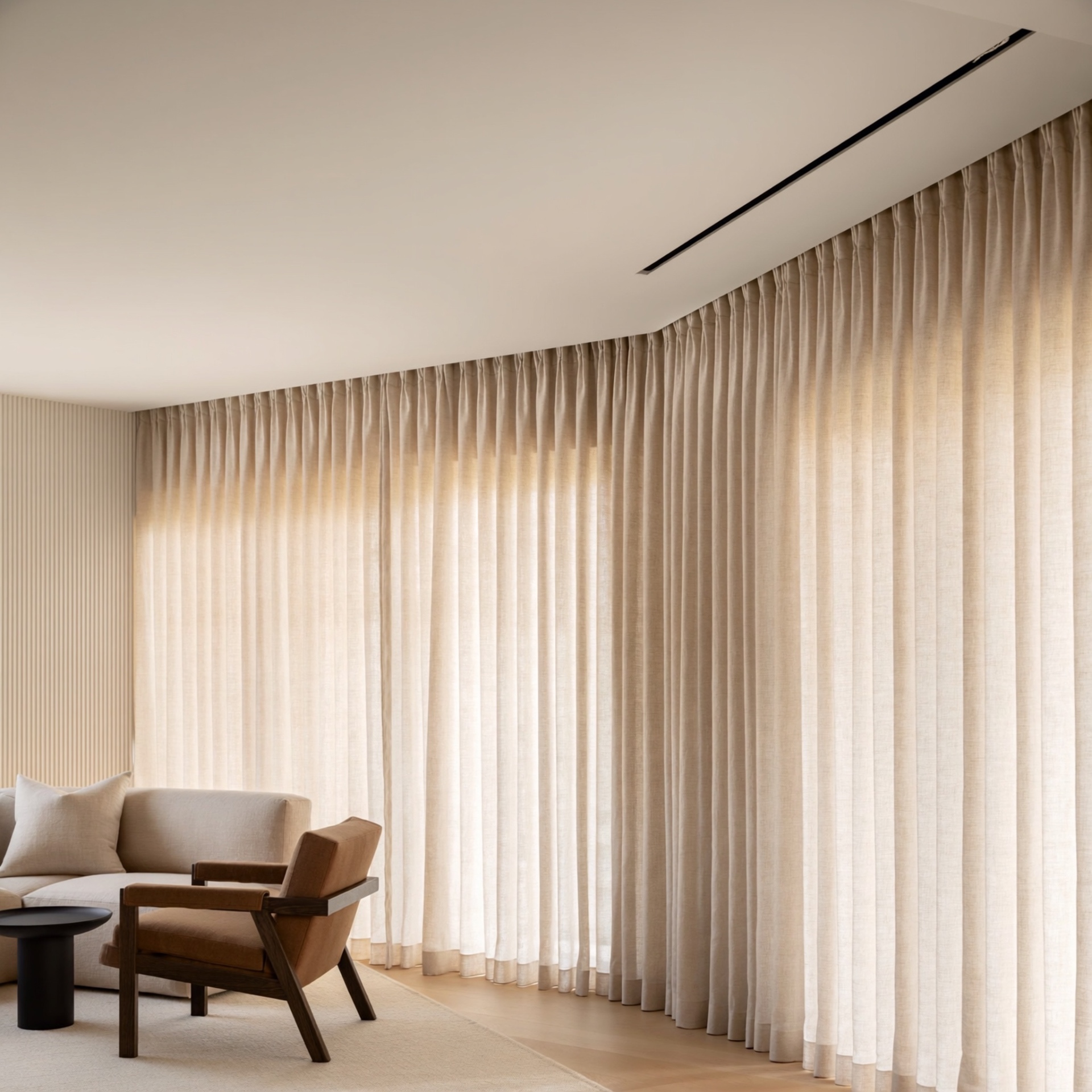
Reseda great room — ceiling-to-floor French pleat drapery in warm oat Belgian linen, mounted on a concealed ceiling track
The difference between ready-made curtains and truly custom drapery is not simply that one is made to order.
Custom draperies are designed as part of the interior.
We consider the relationship between the window and the room: where the treatment should begin and end, how high it should be mounted, how much fabric the proportions can support, how the drapery will stack when open, how it will meet the floor, what the fabric will do in natural light and how the hardware relates to the architecture.
A beautiful fabric cannot correct poor proportions.
That is why measuring, fullness, pleat style, lining, hardware and installation need to be considered together rather than selected independently.
For clients searching for Los Angeles draperies, this distinction matters. The finished product is not simply fabric covering a window. It becomes part of the architecture of the room.
Clients describe this work in different ways — some ask for drapes, some for drapery, and some for custom curtains in Los Angeles, which has a dedicated page of its own.
What Our Los Angeles Custom Drapery Service Includes
House of Drapery oversees custom drapery projects under designer supervision.
Depending on the project, our work can include:
Design consultation
Field measuring
Drapery drawings and specifications
Fabric selection
Sheer and decorative fabrics
Lining and blackout specification
Fullness and pleat specification
Custom fabrication
Drapery hardware
Motorized tracks and motors
Installation
Steaming and hand dressing
Coordination with electricians when required
Coordination with smart-home integrators for programming and commissioning
The exact scope depends on the architecture, treatment and construction conditions.
Our role is to make sure these individual decisions ultimately become one finished drapery system.
Measuring Custom Drapery in Los Angeles
Good drapery begins with good measurements, but measuring a window is only part of the process.
We also evaluate mounting conditions, ceiling height, wall conditions, available stack-back, finished floor conditions, furniture placement, hardware location and the relationship between multiple layers of fabric.
For large windows and walls of glass, a few inches can materially change where a panel parks when it is open and how much glass remains exposed.
For recessed or motorized installations, the available ceiling or pocket space can be just as important as the width and height of the window itself.
That is why we prefer to evaluate the conditions before fabrication rather than try to solve architectural problems after the drapery has already been made.
Fabric Selection for Los Angeles Interiors
Los Angeles gives us extraordinary natural light, but that light changes the way fabric behaves.
A fabric that looks beautiful as a small sample may appear very different when it becomes a floor-to-ceiling drapery panel with daylight behind it.
The fabric also needs to work with the intended construction.
Some materials support a crisp architectural pleat beautifully. Others are better suited to a softer treatment. Sheers need enough body and fullness to create movement without overwhelming the view. Decorative fabrics may require lining for body, privacy, light control or protection.
Fabric selection is therefore not an isolated decorative decision. It is part of the drapery specification.
Fullness Changes the Entire Appearance of Drapery
Fullness determines how much fabric is distributed across the finished width of a treatment.
Too little fullness can make drapery appear flat and under-scaled. Too much can create unnecessary bulk, especially where the fabric must stack into a limited area.
There is no single fullness percentage that is correct for every project.
The right amount depends on the fabric, pleat style, window width, ceiling height, hardware, stack-back and desired appearance.
This becomes especially important with ripple-fold drapery, sheers and large walls of glass, where the relationship between fabric volume and available space must be resolved before fabrication.
Pleats and Headings Define the Drapery
Pleat style changes both the appearance and performance of custom drapery.
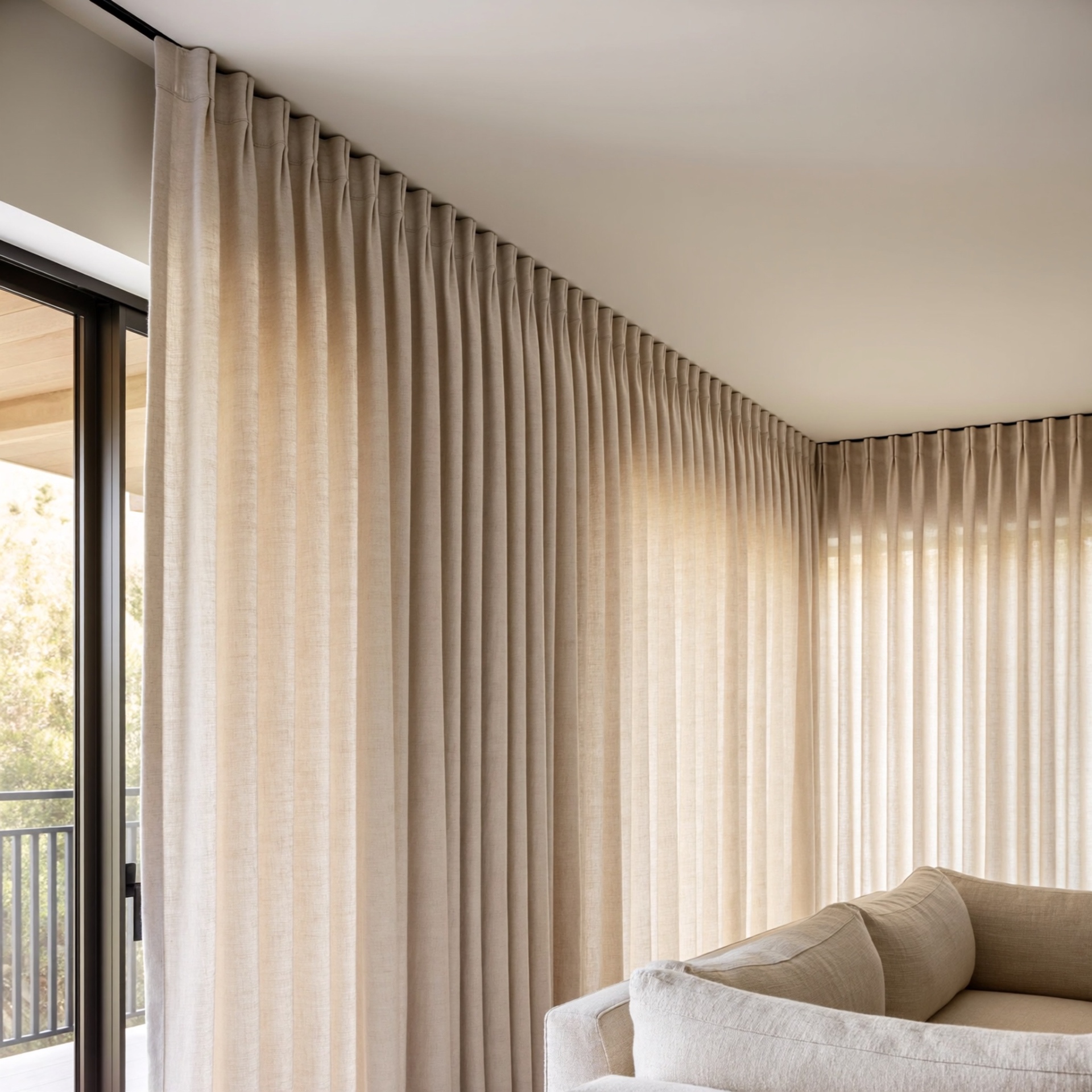
A tailored pleat can create a more structured architectural rhythm. Ripple fold creates a continuous wave and works particularly well in contemporary interiors and large openings. Other headings can create softer or more traditional effects.
But the heading cannot be selected by appearance alone.
Pleat construction affects fullness, stack-back, hardware compatibility and how the fabric hangs.
We specify the heading in relationship to the fabric and architecture rather than treating it as a decorative detail added at the end.
Sheer Drapery and Layered Window Treatments
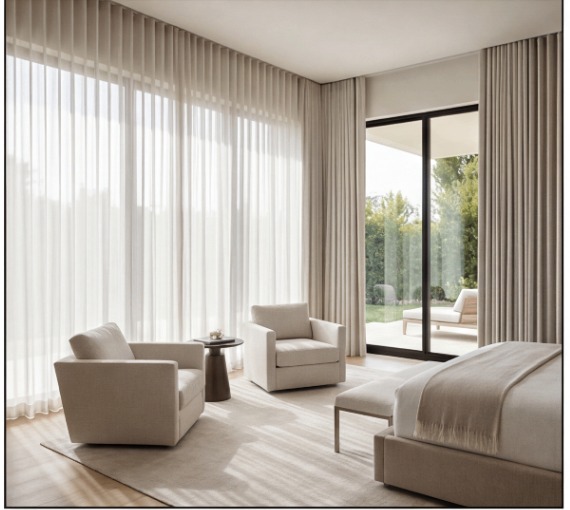
One of the most useful combinations in Los Angeles is a sheer layer paired with a decorative or blackout drapery.
Sheers can soften strong daylight, provide daytime privacy and give a large expanse of glass a finished appearance without completely disconnecting the room from the view.
The second layer can provide additional privacy, light control or blackout when needed.
But layered drapery requires planning.
Two treatments require enough physical space to move independently, sufficient stack-back and compatible hardware. When motorization is involved, track spacing and ceiling conditions become even more important.
Blackout performance is not created by dark fabric alone.
The lining, construction, overlap, return conditions, mounting position and light entering around the perimeter all affect the result.
Bedrooms may require substantial room darkening without making the treatment visually heavy during the day. Media rooms may require a different balance between appearance and light control.
We specify blackout as part of the complete treatment rather than simply adding a blackout fabric behind a decorative panel.
Custom Drapery for Large Windows and Walls of Glass
Beverly Hills estate, contemporary wing — ripple fold on concealed motorized ceiling track, wall-to-wall across sliding glass doors
Large windows are one of the places where custom design becomes particularly important.
A wall of glass may require a substantial amount of fabric, long hardware spans, careful support, sufficient stack-back and a strategy for how the treatment will actually be opened and closed.
The proportions also matter.
Drapery that looks appropriate on a conventional window can appear under-scaled on a large architectural opening.
We evaluate the entire elevation rather than treating each piece of glass as an isolated window.
For very large openings, motorization may also become a practical decision rather than simply a luxury feature.
Motorized Drapery in Los Angeles
Motorized drapery can be useful for large windows, tall treatments, frequently used rooms and projects integrated with a smart-home system.
For new construction, hardwired motorization may be appropriate when the project budget and electrical planning support it.
For existing finished homes where opening walls would be unnecessarily disruptive, rechargeable motorization can be an excellent alternative.
We work with systems including Lutron and Somfy depending on the project requirements.
House of Drapery can oversee the design, measuring, drapery specification, fabrication, tracks, motors and installation while coordinating with the electrician and smart-home integrator when those trades are involved. Programming and commissioning are performed by the appropriate smart-home integrator.
A Construction Mistake We Want Los Angeles Clients to Avoid
One of the most expensive drapery mistakes can happen before the drapery company arrives.
On a recent motorized drapery installation in the Glendale area, the project called for both sheer and regular ripple-fold drapery on motorized Lutron tracks concealed within an architectural ceiling condition.
The space created for the tracks was only about four inches overall, leaving roughly two inches between the sheer and drapery tracks.
That was not enough usable space for both finished treatments to operate properly at the fullness we would normally recommend.
The important lesson is that the space needs to be designed for the finished drapery, not merely for the tracks.
For a double-layer sheer-and-drapery condition, our studio generally recommends evaluating approximately 8–9 inches of usable space, depending on the fabric, fullness, hardware and specific construction. This is a House of Drapery design recommendation based on project conditions, not a universal manufacturer specification.
If a recessed ceiling condition needs to be constructed, a general contractor would typically perform that architectural work. We can provide the drapery requirements and coordinate with the relevant trades.
The best time to resolve this is before the ceiling is closed.
Custom Drapery Fabrication and the Workroom
Once the design has been resolved, the specification has to become an actual finished product.
In the drapery workroom, measurements and design decisions translate into cutting, seaming, pattern placement, pleat construction, lining, hems and the final dimensions of the treatment.
This is where details that may look small on paper become very visible.
Pattern alignment, seam placement, hem depth, pleat consistency and how the fabric responds to the selected construction all contribute to the finished appearance.
Designer supervision between specification and fabrication helps maintain continuity between what was envisioned for the room and what is ultimately installed.
Professional Drapery Installation Matters
Even beautifully fabricated drapery can look wrong if it is installed poorly.
Hardware needs to be positioned correctly and securely. The finished length needs to relate properly to the floor. Panels need to travel correctly. Returns and overlaps need to perform as intended.
After installation, the fabric also needs attention.
We steam and dress the drapery so the folds, pleats and overall presentation settle into the intended shape.
Installation is not simply the last labor item on the project. It is the point where the specification, fabrication, hardware and architecture finally come together.
Custom Drapery for New Construction and Remodels
The best time to discuss drapery on a construction project is often earlier than people expect.
Recessed tracks, ceiling pockets, blocking, electrical requirements, motor locations, access and stack-back can all be affected by construction decisions.
House of Drapery can coordinate drapery requirements with the general contractor, electrician and smart-home integrator so that the architecture supports the finished treatment.
We do not replace those trades.
Our responsibility is to design and oversee the drapery portion of the project and communicate what the finished window treatment requires.
Early coordination can prevent expensive corrections later.
Existing Homes Do Not Need to Be Rebuilt for Custom Drapery
Custom drapery is equally appropriate for completed homes.
Many projects can be designed around existing architectural conditions without opening walls or making unnecessary construction changes.
Depending on the project, we can evaluate existing hardware, determine whether it can be reused, specify new hardware where needed and determine whether existing drapery can reasonably be altered.
Rechargeable motorization also gives existing homes more flexibility because automation does not necessarily require opening finished walls for electrical wiring.
The correct solution depends on the actual conditions, which is why we evaluate the project rather than prescribing the same system for every home.
Custom Drapery Projects Across Los Angeles
Reseda Great Room Drapery — French pleat in warm oat Belgian linen on a concealed ceiling track spanning the full wall
Reseda Great Room Drapery — an eleven-foot great room where the drapery was mounted at the ceiling rather than above the window opening. French pleat panels in warm oat Belgian linen, interlined, hand-drawn on a concealed track spanning the full wall.
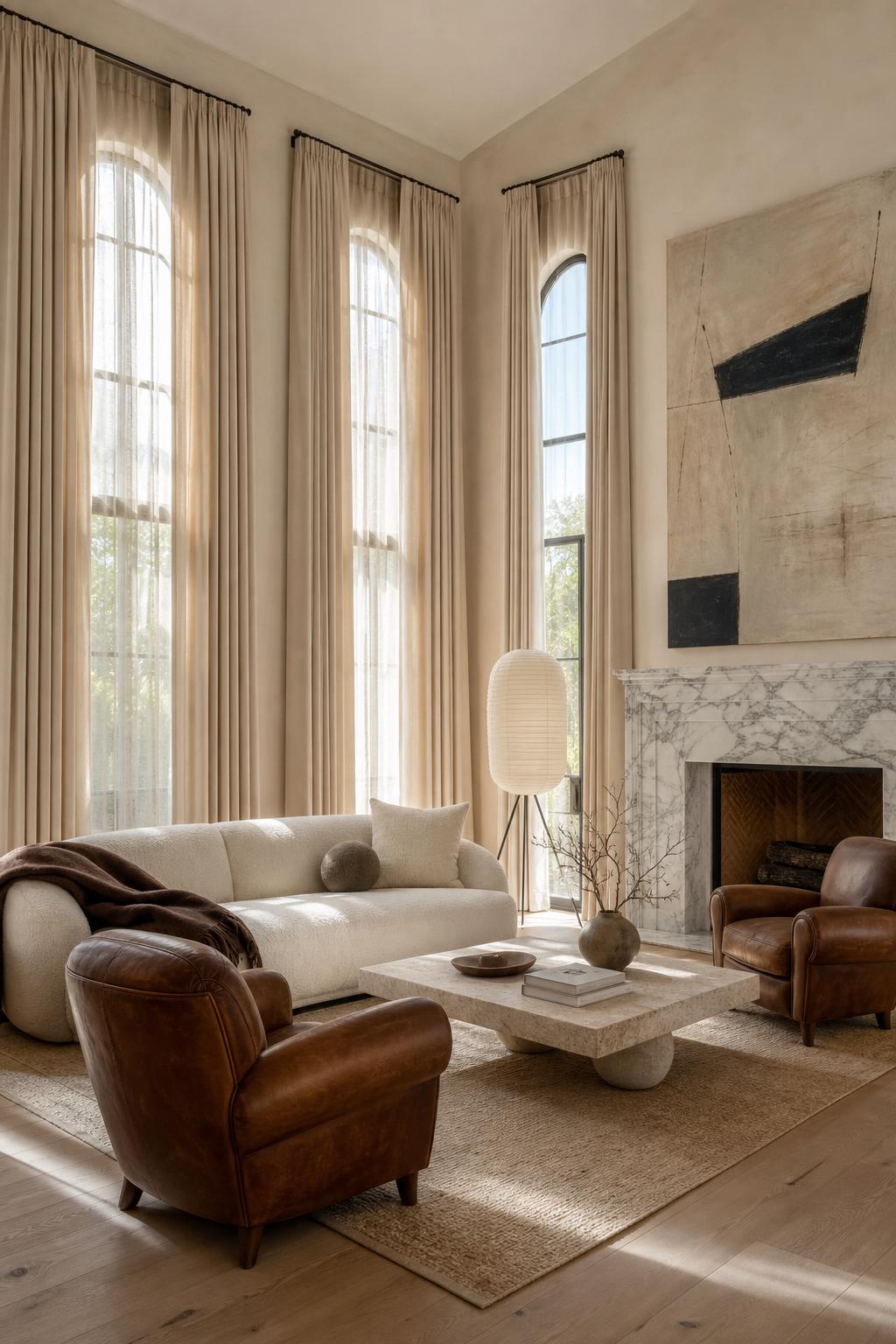
Beverly Hills Estate Window Treatments — French pleat in heavy off-white wool blend, ceiling-mounted across three openings in the formal living room
Beverly Hills Estate Window Treatments — a full estate program of 32 openings resolved as two related families of drapery, French pleat in the formal rooms and suites and ripple fold in the contemporary additions, on concealed motorized track integrated with the home's existing keypads.
Los Angeles Executive Office & Boardroom — a Signature Design Concept, not a completed installation: an editorial study of a Century City executive program pairing an acoustic-rated wool boardroom layer on recessed motorized track with a champagne solar sheer, alongside a private office in taupe wool flannel on hand-forged brass.
Serving Los Angeles and West Hollywood
House of Drapery works with residential clients, interior designers, architects, builders and trade professionals throughout Los Angeles.
What Determines the Cost of Custom Drapery in Los Angeles?
There is no responsible single price for custom drapery because the specification can vary dramatically from one project to another.
Cost can be affected by:
Window dimensions
Number of windows
Fabric selection and yardage
Fullness
Pleat or heading construction
Lining
Pattern matching
Hardware
Ceiling and mounting conditions
Motorization
Installation complexity
Access
Construction coordination
A large motorized wall of glass with layered sheers and decorative drapery is fundamentally different from a single stationary decorative panel.
We prefer to understand the room and requirements before recommending a solution. How those variables move a budget is set out in the studio pricing guide.
Do All Windows Need Custom Drapery?
No.
A good drapery plan does not require putting fabric on every window.
Some windows benefit from drapery because they need softness, scale, privacy, blackout, acoustic benefit or stronger architectural presence.
Others may be better served by Roman shades, solar shades, another window treatment or sometimes nothing at all.
We design the treatment around the room rather than trying to sell the same product for every opening.
FAQs · Los Angeles
Custom Drapery in Los Angeles: Frequently Asked Questions
What is the difference between custom drapes and custom drapery?
Clients often use drapes, curtains and drapery interchangeably. In a custom project, what matters is that the treatment is designed and fabricated for the specific window, room, fabric, hardware and performance requirements rather than purchased in a predetermined ready-made size.
How do I choose custom drapery for my Los Angeles home?
Begin with the room rather than the fabric alone. Consider the architecture, window dimensions, natural light, privacy, furniture placement, desired fullness, heading, lining, hardware and how frequently the treatment will be opened and closed. A consultation allows these decisions to be considered together.
Do you measure for custom drapery?
Yes. Measuring is part of the projects we oversee. We evaluate the window as well as relevant mounting conditions, finished height, hardware location, stack-back and other conditions that affect the completed treatment.
Do you provide the fabric?
Yes. Fabric selection can be part of the custom drapery process. We consider appearance together with weight, hand, transparency, construction, fullness, lining and the way the fabric behaves in the room’s natural light.
Do you fabricate the drapery?
Yes. Custom fabrication is part of the process we can provide and oversee under designer supervision, from specification through the workroom and final installation.
Do you install custom drapery in Los Angeles?
Yes. We provide professional drapery installation as part of our projects, including final steaming and dressing of the finished treatments.
Can you make sheer and blackout drapery for the same window?
Yes. Layered sheer and decorative or blackout treatments can provide different levels of privacy and light control. The hardware, spacing, fullness and available stack-back need to be planned so both layers can operate correctly.
Do you provide motorized drapery?
Yes. Motorization can be incorporated into custom drapery projects when appropriate. Depending on the project, systems may be hardwired or rechargeable, and we can coordinate our portion of the work with electricians and smart-home integrators.
Can motorized drapery be added to an existing home?
In many cases, yes. Rechargeable motorization can be particularly useful in finished homes because it may avoid opening walls for new electrical wiring. Existing conditions still need to be evaluated before specifying a system.
Can drapery tracks be recessed into the ceiling?
Yes, when the architecture provides sufficient usable space for the finished drapery and hardware. If a new ceiling recess or pocket needs to be constructed, that architectural work would typically be performed by a general contractor, with the drapery requirements coordinated in advance.
How much space should I leave for sheer and drapery tracks?
It depends on the hardware, fabric, fullness and construction. For double-layer sheer and drapery installations, our studio generally recommends evaluating approximately 8–9 inches of usable space rather than designing the recess around the track dimensions alone. The exact condition should be reviewed before construction.
Do you work with interior designers, architects and builders?
Yes. House of Drapery works with residential clients and trade professionals and can coordinate drapery specifications with the appropriate members of the project team.
Do you provide custom drapery in West Hollywood?
Yes. West Hollywood is part of our Los Angeles service area, and we also maintain a dedicated West Hollywood custom drapery page for clients looking specifically for service in that area.
How long does custom drapery take?
Timing depends on the fabric, fabrication requirements, hardware, motorization, project size and installation conditions. We establish the project requirements before giving a meaningful schedule rather than applying one timeline to every treatment.
The Consultation
Begin Your Los Angeles Drapery Project
The best custom drapery begins with understanding the room.
House of Drapery by Duroque provides designer-supervised custom drapery in Los Angeles, from measuring, fabric and specification through fabrication, hardware, installation and final dressing.
Whether you are designing one important room, a wall of glass, a layered sheer-and-drapery treatment or coordinating window treatments for a larger construction project, we can evaluate the conditions and develop the appropriate solution.
You don’t need to have every detail figured out before getting in touch. Photos and measurements are helpful, but not required. We can begin with what you know.