
Blackout Drapery With Integrated Lining
The decorative face fabric and blackout lining are constructed as one treatment. Both move together on the same track.
Blackout is not one type of curtain.
House of Drapery by Duroque designs custom blackout window treatments around the room, the window architecture and the way each layer should operate. The solution may be decorative drapery with integrated blackout lining, an independent blackout layer, layered sheer and blackout drapery, a Roman shade, or a compatible manual or motorized treatment.
The fabric is only one part of the result. Track placement, finished dimensions, returns, panel overlap, floor and ceiling relationships, and professional installation all influence perimeter light leakage and the finished appearance.
Complimentary Design Consultation · Los Angeles
Blackout is not one specific type of curtain. It is a light-control component that can be designed into a window treatment in several different ways.
A blackout layer can operate independently on its own track, either manually or with compatible motorization. It can also be designed as a blackout Roman shade or another independent window treatment, allowing the blackout layer to be opened and closed separately from the decorative drapery.
This integrated construction is particularly useful in layered treatments. A room may have light-filtering sheers on one track and decorative drapery with integrated blackout lining on a second track. During the day, the sheer can soften daylight and provide a degree of privacy. When greater darkness is wanted, the lined drapery closes over it.
The right approach depends on how the room is used, the fabric, window architecture, desired appearance, operation and level of light control.
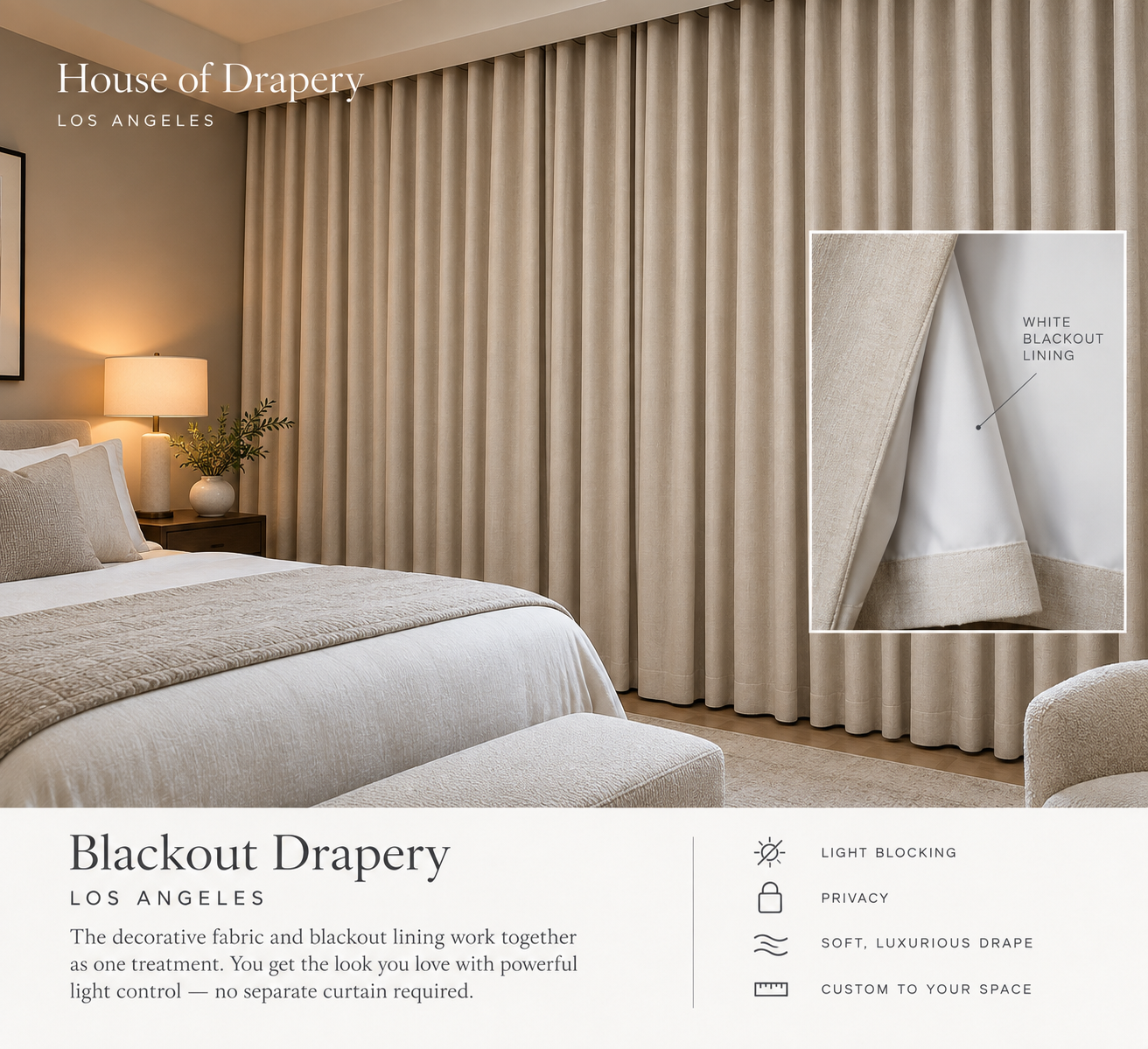
The decorative face fabric and blackout lining are constructed as one treatment. Both move together on the same track.
Blackout operates separately from the decorative treatment on its own track, allowing each layer to be controlled independently.
A light-filtering sheer operates on one track, with decorative drapery incorporating blackout lining on the second. This provides very different daytime and nighttime conditions within one window treatment.
Explore custom sheer draperyBlackout can also be incorporated into Roman shades and compatible motorized window-treatment designs where appropriate to the project.
Explore custom Roman shades or motorized drapery for deeper treatment-specific guidance.
Blackout performance is created by the whole treatment, not by the fabric alone. Light can still enter above, below, beside or between panels when the track, returns, overlap, fullness and finished length are not considered together. Reducing those gaps depends on the complete installation and the conditions of the room, so no blackout construction should be understood as a universal promise of absolute darkness.
House of Drapery considers the entire installation.
The objective is to minimize unintended light gaps while maintaining the intended appearance and operation of the drapery.
For rooms where stronger light control is important, the details around the edges of the treatment matter just as much as the blackout material itself.
Related planning: recessed drapery tracks and professionally coordinated drapery installation.
Blackout treatments can support sleep and privacy when the fabric, construction, dimensions, track placement, returns and panel overlap are considered together. The right configuration depends on the room and the level of light control wanted.
Rooms used for projection may require stronger control of perimeter light. The window architecture, operating method and the edges of the treatment are reviewed alongside the selected blackout construction.
A separate sheer can soften daylight and provide a degree of daytime privacy, while blackout-lined decorative drapery closes when greater darkness is wanted.
Blackout treatments may be manually operated or designed with compatible motorization. The appropriate approach depends on the treatment, scale, access, architecture and project requirements.
Blackout and room-darkening treatments are not interchangeable terms. Room-darkening construction reduces and softens incoming light, while blackout construction is selected when substantially stronger light control is wanted.
The correct choice depends on the function of the room and the desired result. A living room may need softened daylight and privacy; a bedroom, nursery or media room may call for a more complete blackout treatment.
In both cases, the face fabric, lining, architecture, dimensions and operating method are specified as part of one finished treatment.
For projects requiring flame-performance considerations, House of Drapery can also review fire-rated fabric options with integrated blackout properties, subject to the requirements and documentation of the selected material.
These textiles can be particularly relevant to hospitality, commercial and other projects where applicable fire-performance requirements are part of the specification.
House of Drapery reviews the fabric, blackout performance, construction and intended application together rather than treating “blackout” as a one-material-fits-every-window specification.
Explore commercial drapery services.Blackout fabrics and linings can differ considerably in weight, hand, drape and finished appearance.
During a Los Angeles design consultation, House of Drapery can review appropriate samples with you and determine whether the project is better suited to integrated blackout lining, an independent blackout layer, a Roman shade, a layered sheer-and-blackout treatment, or compatible motorization.
The complete treatment can also be coordinated with custom drapery design in Los Angeles.
House of Drapery provides custom blackout window-treatment services throughout Los Angeles, including West Hollywood, Beverly Hills, Bel Air, Holmby Hills, Brentwood, Santa Monica, Pacific Palisades, Malibu, Venice and the Hollywood Hills.
The studio also serves appropriate projects in Studio City, Sherman Oaks, Encino, Woodland Hills, Calabasas, Hidden Hills, Agoura Hills, Westlake Village and Thousand Oaks, with Santa Barbara considered as an additional service area.
Review the room, window architecture, desired appearance, operation and level of light control with House of Drapery by Duroque.
Lining is one of the quietest decisions in a drapery specification and one of the most consequential. It changes how the fabric feels, how the room sleeps, and how long the panel will look the way it did on installation day.
A cotton-sateen liner behind the face fabric. It softens daylight, gives the panel body and drape, and protects the face fabric from sun. Standard lining is the right answer for living rooms, dining rooms, offices, and any window where the goal is to filter light beautifully rather than eliminate it.
A three-layer construction — face fabric, interlining, and a dense blackout liner — designed for rooms that must be genuinely dark. For a true seal, we detail side channels, extended returns, and a recessed pocket at the top so light does not leak around the panel. Reserved for primary bedrooms, nurseries, media rooms, and any west-facing room where sleep or projection is the brief.
A common request is to blackout every window in the house. In practice, blackout belongs where it earns its keep; over-specifying it can make daytime rooms feel closed. The consultation is where we decide, room by room, which lining serves the way the family actually lives.
Blackout is a function before it is a fabric. The way we agree on light, sleep, room use and architecture during the consultation is what makes the finished treatment work — and that conversation is documented in our Standards.

Prefer to speak with us directly?