
Sheer as a Standalone Treatment
A sheer can be designed on its own track as the only treatment at the window, filtering daylight and softening the architecture while the glass and the view remain the subject of the room.
Sheer changes the atmosphere of a room before it does anything else. Daylight arrives diffused rather than direct, the cloth carries the faintest movement of air, and the texture of the weave becomes visible against the light. A window dressed in sheer reads as finished and inhabited, even when the heavier decorative drapery is drawn fully open.
It is also one of the most flexible categories of custom window treatment. Sheer can stand alone at the window, layer behind decorative drapery, sit in front of a blackout-lined panel, or be made into a soft light-filtering shade — and the right answer depends entirely on the room, the light and the way the space is used.
A transparent look at how we work from first call to final install is available for clients considering the studio.

Sheer is not one curtain. The word describes a family of light-filtering textiles, and what unites them is transparency — the ability to hold a window while still letting the room read as open. Fine and plain sheers, linen sheers, organza, striped weaves, textured cloths and coloured sheers, among many other light-filtering textiles, all behave differently: in how much daylight they pass, how they hang, how they hold a fold and how they look from across the room.
House of Drapery works with a very large range of sheer textiles and samples, which matters more than it sounds. Two fabrics described in the same way on a swatch card can produce entirely different rooms once they are hung at height and seen against the actual light of the window.
A sheer is often chosen to coordinate with or complement an existing decorative fabric, rather than defaulting to a neutral. Colour, weave and density are considered in relation to the scheme already in the room.
Related reading: the sheer fabrics library and linen drapery in Los Angeles.
A sheer can be designed on its own track as the only treatment at the window, filtering daylight and softening the architecture while the glass and the view remain the subject of the room.
A sheer operates on one track with decorative drapery on a second, so the room can be dressed in daylight and closed in the evening without changing the character of the window.
A sheer can operate on one track while decorative drapery with blackout lining integrated into it operates on another. The sheer carries the daytime condition; the lined panel carries stronger light control when it is wanted, so daytime and nighttime can be treated differently at the same window.
Explore blackout drapery in Los AngelesSheer and other light-filtering textiles can be made into Roman shades and other appropriate shade treatments where a soft, tailored, fabric-forward treatment suits the window better than a panel.
Explore custom Roman shadesWith an appropriately designed recessed or concealed track, a sheer can appear to emerge from the ceiling, which suits tall glass, walls of glass and contemporary interiors.
Explore recessed drapery tracks
Sheer treatments may be made with Ripplefold or S-fold, inverted pleat, French pleat, goblet pleat and other appropriate constructions. Not every sheer textile suits every heading equally: fabric, fullness, heading, carrier and hardware, and the appearance intended for the room are considered together rather than chosen one at a time.
Fullness follows the same logic. A very transparent cloth may benefit from greater fullness to gain presence, while a textured or heavier sheer may already carry enough body at less. The heading and the fullness are decided together, because each one changes how the other reads.
Finished length is a design decision as much as a measurement, and it changes the character of the panel at the floor.
The right finish depends on the textile, the room, the flooring, how often the treatment is operated and the appearance wanted — it is not a single house rule applied to every window.
For the heading itself, see the studio note on ripple fold drapery.
A sheer softens daylight. Depending on fabric density and the lighting conditions at the window, it may also provide useful daytime screening, reducing how clearly the interior reads from outside while daylight is the stronger source.
At night that relationship reverses. When interior lighting is brighter than the light outside, visibility through sheer fabric can increase. This is a property of the material and the lighting condition, not a fault in the treatment — and it is why stronger nighttime privacy generally requires a second layer.
No sheer should be understood as a promise of complete privacy. Where privacy is a priority, the sheer is designed alongside a decorative panel, a blackout-lined treatment or a shade, so the room has a considered answer for both conditions.
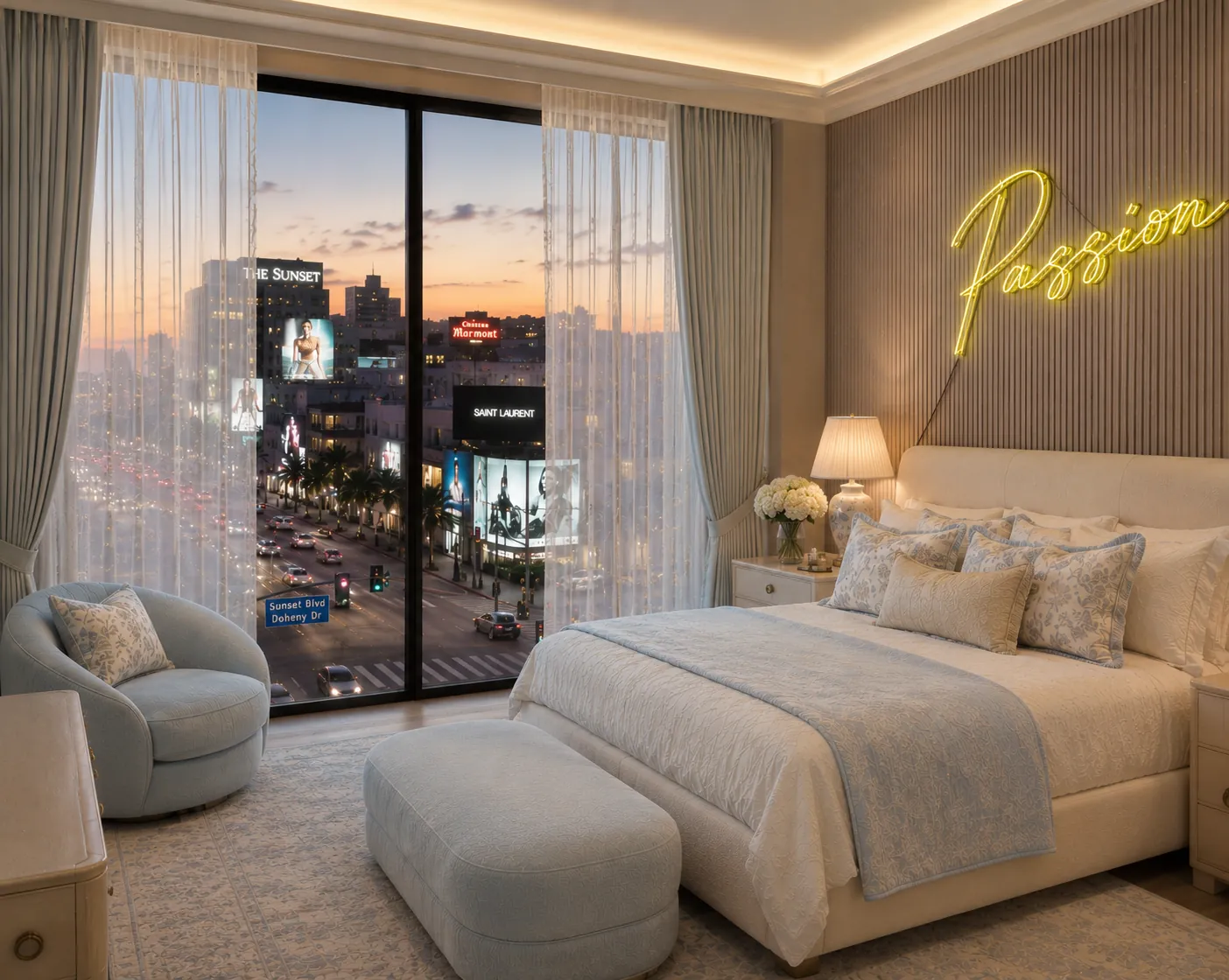
Sheer treatments may be operated by hand or designed with compatible motorized operation. Because sheer fabric is light, the track, the finished weight of the panel and the method of operation are considered together — a panel that moves well by hand does not automatically behave the same way on a motorized track, and the reverse is equally true.
Where a sheer and a decorative or blackout-lined panel are layered, the operating method for both layers is decided at the same time as the track configuration.

Sheer is at its most romantic in a bedroom. Morning light arrives softened rather than direct, the fabric moves with the room, and a blackout-lined decorative panel can be layered behind it for sleep. In an appropriate design, a track can also be configured around the bed area so sheer fabric forms a contemporary canopy-like enclosure — a quiet architectural gesture rather than a universal recommendation.
Across a large expanse of glass, an unbroken run of sheer becomes architectural — a continuous plane of light and texture that gives scale to the wall while the outlook remains present. When heavier decorative drapery is drawn open, the sheer keeps the window visually finished rather than bare.
A sheer holds the room together in daylight and reads as a quiet textile plane in the evening, particularly when its colour and texture are drawn from the existing scheme rather than treated as a neutral default.
Where daytime screening matters, fabric density is reviewed against the actual light conditions at the window. What screens well in the middle of the day behaves differently at dusk, and the design accounts for that rather than assuming it away.
A sheer rarely works in isolation from the rest of the room. It can be paired with decorative textiles including linen, wool, silk and other appropriate face fabrics, and the two are reviewed together — weight against weight, colour against colour, texture against texture.
Where decorative drapery already exists, or a face fabric has already been selected, the sheer is chosen to coordinate with or complement it. The objective is a window that reads as one designed treatment rather than two separate purchases.
Certain covered outdoor settings — loggias, terraces and similar structures — can be designed with appropriate exterior sheer fabrics, where the textile, hardware and installation are selected for that exposure.
Interior sheer textiles are not suitable for exterior use. Whether an outdoor application is appropriate at all depends on the location, the exposure and the structure available to support the treatment.
Track, fabric, fullness, heading, finished weight, operation and installation conditions are one decision made in several parts. A fabric chosen without regard to the track, or a track chosen before the fabric is known, is where most disappointing sheer treatments begin.
Ceiling depth, wall construction, window architecture and the space available for the panel to stack all inform what can be built. These are reviewed at the window rather than assumed from a drawing.
Related: recessed drapery tracks in Los Angeles and drapery installation in Los Angeles.
House of Drapery designs custom sheer drapery for homes and interiors across Los Angeles and the surrounding communities, including Beverly Hills, Bel Air, Malibu, Pacific Palisades, Santa Monica, Brentwood and West Hollywood.
Light behaves differently across the city — orientation, surrounding buildings, reflected light from water or paving, and the height of the glass all change what a given sheer will do. The fabric is considered against the conditions at your windows rather than in the abstract.
They describe the same treatment in two registers. Sheer drapery refers to the designed and constructed treatment — textile, heading, fullness, track, finished dimensions and operation — while sheer curtains is the everyday term. Both are light-filtering panels; the difference is in how carefully the treatment is designed.
No. Sheer is a broad category of light-filtering textile rather than a single style. It includes fine and plain sheers, linen sheers, organza, striped, textured and coloured options, among many others, and it can be designed as a panel, layered with other treatments, or made into a shade.
A sheer can provide useful daytime screening depending on fabric density and the lighting conditions at the window, but no sheer should be understood as a promise of complete privacy. Where privacy is a priority, the sheer is designed alongside a second treatment.
Generally less so. When interior lighting is brighter than the light outside, visibility through sheer fabric can increase. Stronger nighttime privacy usually requires another layer, such as decorative drapery, a lined panel or a shade.
Yes. A sheer can be designed as a standalone treatment on its own track where filtered daylight and softened architecture are the objective and stronger light control is not required at that window.
Yes. Sheer and other light-filtering textiles can be incorporated into Roman shades and other appropriate shade treatments when that construction suits the window, the fabric and the way the room is used.
Sheer treatments may use French pleat, inverted pleat, Ripplefold or S-fold, and other appropriate constructions. The heading is selected according to fabric and hardware compatibility, the finished weight of the panel and the appearance intended for the room.
Finished length can be designed to kiss the floor, sit slightly off the floor, break at the floor, or intentionally puddle. The decision depends on the textile, how the treatment is used and the appearance wanted, and it is made with the track and installation conditions in view.
Sheer treatments may be manually operated or designed with compatible motorized operation. Because sheer fabric is light, the track, the finished weight of the panel and the method of operation are considered together rather than chosen separately.
Yes. A sheer can be selected to coordinate with or complement an existing decorative textile, including linen, wool, silk and other appropriate face fabrics, so the two layers read as one considered treatment.
Certain outdoor applications can be designed using appropriate exterior sheer fabrics. Indoor sheer textiles are not suitable for exterior use, and the specification depends on the location, exposure and structure involved.
Yes. House of Drapery works with a very large range of sheer textiles and samples, and a consultation is where fabric density, hand, colour and drape are reviewed against the actual light at your windows.
A complimentary consultation is where fabric density, heading, track and finished length are reviewed against the actual conditions at your windows.
Wondering whether sheers would suit the room at all? A designer can look at the room itself before any treatment is decided.
Sheers behave differently in every orientation and on every exposure. The walk-through documented in our Standards is where the right sheer for a room is actually determined.

Prefer to speak with us directly?
Begin with a private consultation. We will follow with a tailored proposal, fabric direction, and an honest opinion on what your room is asking for.