
- 20+ Years of Design Experience — Olga Rechdouni, ASID
- ASID Professional Member
- Custom Design · Fabrication · Installation
- Luxury Homes Throughout Los Angeles
Motorized Drapery in Los Angeles
Motorized Drapery Designed Around the Room
Motorized drapery should begin with the drapery, not the motor.
At House of Drapery by Duroque, we design motorized window treatments around the architecture, the way the room is used, the size of the opening, privacy and light requirements, fabric, fullness, stack-back, and the way the finished panels need to move.
Only then do we specify the track, motorization, and control requirements.
We provide a designer-supervised process that can include consultation, professional measuring, drawings, fabric selection, custom fabrication, motorized tracks and motors, installation, steaming and dressing, and coordination with the electrician and smart-home integrator.
For integrated projects, we oversee the drapery design and its relationship to the architecture while the appropriate smart-home integrator handles programming and commissioning of the automation system.
That distinction matters. A motor can move a track. The finished drapery still has to fit, stack, clear adjacent treatments, and move beautifully.
What Is Motorized Drapery?
Motorized drapery uses a powered track system to open and close fabric panels automatically rather than requiring the drapery to be operated entirely by hand.
Depending on the selected system and project, operation may include a wall control, remote, compatible app, programmed scenes, or integration with a compatible smart-home platform.
Motorization is particularly useful for large windows, floor-to-ceiling glass, difficult-to-reach treatments, bedrooms, layered sheer and blackout treatments, and rooms where the drapery is opened and closed frequently.
But we do not believe every window automatically needs a motor.
The decision should solve a real design or lifestyle problem.
Do All Windows Need Motorization?
No.
Motorization is valuable when it makes the room easier to use or solves an architectural problem. On a small, easily accessible window that is rarely adjusted, manual drapery may be completely appropriate.
On a large wall of glass, however, repeatedly pulling substantial fabric across a wide opening can become inconvenient. The larger and heavier the treatment, the more meaningful automated operation can become.
Sometimes the reason is even simpler.
On one residential project, the clients had a large primary bedroom and enjoyed watching television from bed. Closing a substantial window treatment manually every evening meant getting up and operating large drapery panels by hand. Motorization allowed the room to work around the way they actually lived.
Would we use motorized drapery in our own home? Yes. The convenience is real.
That still doesn’t mean we recommend paying to motorize a window where the client will receive little benefit from it.
Planning a Motorized Drapery Project?
Tell us about the windows, construction stage and automation requirements. If you already have plans, photos or measurements, you can send those too.
How We Specify a Motorized Drapery System
Compatible custom drapery can be designed for motorized operation, but the motor is not selected as an isolated piece of technology. The motor, track, fabric construction, finished weight, opening direction, stack-back, hardware clearances and site conditions work as one system, and a configuration that fits on paper can still be wrong for the finished drapery. We look at the complete finished treatment:
- window and wall dimensions
- fabric
- lining
- finished drapery weight
- fullness
- pleat or heading
- track length
- direction of draw
- stack-back
- single or layered treatments
- mounting conditions
- available ceiling or wall clearance
- recessed-pocket conditions
- motor and power requirements
- controls and integration
- access for installation and future service
That is why measuring and specification need to happen together.
Drapery Weight, Fabric and Fullness Matter
The motor isn’t moving an empty track. It is moving a finished textile treatment.
Fabric weight, lining, fullness, heading construction, and the overall dimensions of the panels affect how the drapery behaves on the track.
A lightweight sheer and a substantial lined drapery do not impose the same demands on a motorized system.
Fullness also has physical depth. Increasing fullness creates more fabric that must stack somewhere when the treatment is open and requires adequate space for folds to form and travel when the treatment is moving.
This is why we do not specify a motor simply from the width of the window.
The motorized system must be designed around the finished drapery configuration.
Recessed Motorized Drapery Tracks and Ceiling Pockets
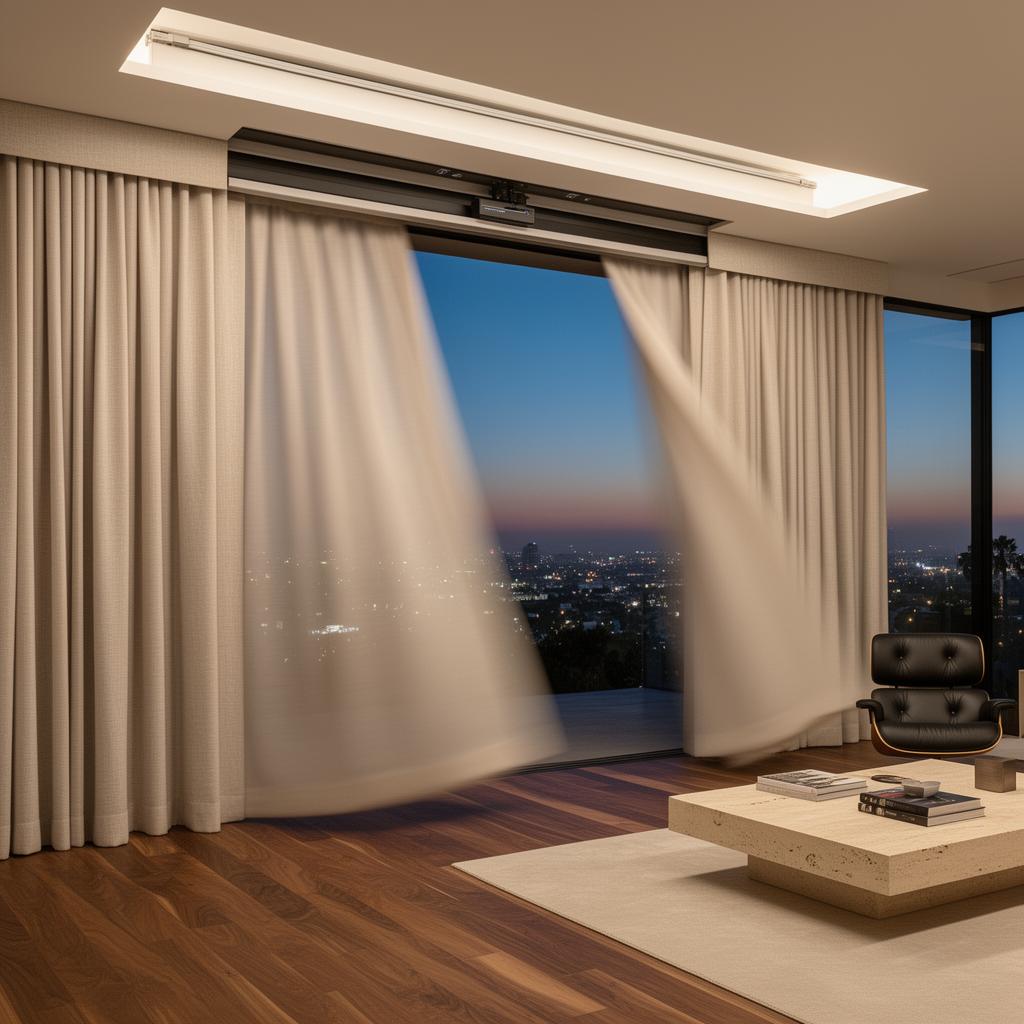
Motorized drapery tracks can be concealed within a properly designed ceiling recess or pocket.
When properly planned, a concealed track can make the drapery appear to emerge directly from the ceiling rather than hanging from visibly applied hardware. This can be particularly effective in contemporary interiors and rooms with large expanses of glass.
House of Drapery specifies the drapery, track, spacing, clearance, and relevant architectural requirements for the window treatment. The actual recessed ceiling or pocket construction is typically completed by the general contractor as part of the architectural work.
Electrical work is handled by the appropriate electrician where required.
Recessed motorized drapery needs to be planned early. The pocket must accommodate more than the physical track. It also needs to account for the finished fabric, fullness, track spacing, motor location, adjacent layers, and the space the drapery needs to move without interference.
Have Plans, Photos or Window Measurements?
Send us what you have. House of Drapery can review your project requirements, window dimensions, inspiration images or specifications before the consultation.
The Track Fits. Will the Drapery Fit?
This is one of the most important distinctions we make during construction.
Enough room for two tracks does not necessarily mean there is enough room for two finished layers of drapery.
We recently encountered exactly this condition on a motorized drapery project in the Glendale area.
The project called for layered drapery on double Lutron tracks: a sheer treatment together with ripple-fold drapery.
The recessed ceiling condition had already been constructed before our installation. The available pocket was approximately four inches, leaving roughly two inches between the motorized track positions.
The hardware could occupy the space.
The finished drapery could not perform in that space at the fullness we wanted.
Ripple-fold drapery has depth. Once the sheer, regular drapery, fullness, and movement of both layers were considered, there was not enough clearance for the two treatments to move properly without substantially compromising the design.
How Much Space Does Double-Track Motorized Drapery Need?
There is no universal pocket dimension that applies to every motorized drapery project.
For certain layered sheer-and-drapery conditions, based on our experience, we may recommend planning approximately 8 to 9 inches of usable space so the treatments have room to form and move properly.
That is a design recommendation, not a universal Lutron specification.
The actual dimension should be determined from the selected tracks, fabric, heading, fullness, motor configuration, and architectural conditions before the pocket is constructed.
The important principle is:
Design the pocket around the finished window treatment, not simply around the dimensions of the tracks.
Bring the Drapery Designer in Before the Ceiling Is Closed
Some of the most expensive motorized-drapery mistakes happen before the drapery workroom ever receives the fabric.
A smart-home integrator understands controls and system integration. An electrician understands power. A general contractor builds the architectural condition.
The drapery specialist has another responsibility: understanding the physical behavior of the finished textile treatment.
We are thinking about fabric, lining, fullness, pleat geometry, track spacing, stack-back, clearance, how two layers move past each other, and what the drapery will look like when both open and closed.
These disciplines should coordinate before recessed pockets, power locations, and finished ceiling conditions become difficult to change.
For new construction and major renovations, involving House of Drapery early allows us to provide measurements and drawings and coordinate the drapery requirements with the project team before fabrication and installation.
Hardwired or Rechargeable Motorized Drapery?
Both can be appropriate.
Hardwired Motorization
For new construction or a substantial renovation, hardwired motorization can be an excellent option when the client wants a highly integrated system and the project budget supports the required electrical work, equipment, and coordination.
Planning it early also allows power and concealed architectural conditions to be incorporated before finishes are complete.
But new construction does not automatically mean every window should be hardwired or motorized.
We consider the benefit to the client against the cost and complexity.
Rechargeable Motorization
Rechargeable motorization can be particularly attractive in an existing finished home where opening walls or introducing new electrical work would be unnecessarily disruptive.
It can provide the convenience of motorized operation without requiring the same rough-in as a hardwired system.
Rechargeable solutions can also be appropriate for other compatible window treatments, including certain shades and blinds.
The right answer depends on the treatment, window, frequency of use, desired integration, and budget.
Lutron or Somfy for Motorized Drapery?
We do not begin with the assumption that one brand is universally better.
We select and coordinate the system according to the project.
Lutron offers a premium integrated ecosystem that can make sense when motorized window treatments are being considered as part of a broader lighting, shading, and control environment.
Somfy is strongly focused on motorization and its technology is used across a broad range of window-treatment and shading applications.
The decision should consider the home’s existing or planned control environment, the window treatment itself, construction conditions, desired functionality, and project budget.
House of Drapery’s role is to make sure the motorization decision works with the actual drapery design while coordinating with the appropriate project professionals responsible for electrical and smart-home integration.
Motorized Sheers and Drapery
Layering is one of the most useful applications of motorization.
A sheer can soften daylight and provide a degree of daytime screening while maintaining a lighter relationship with the view. A second drapery layer can provide greater privacy, decorative impact, light control, or blackout performance depending on its construction.
Both layers can be motorized when the project calls for it.
But a double-track treatment requires more planning than simply placing two tracks beside one another.
We consider track spacing, fabric depth, fullness, stack-back, finished panel movement, and ceiling or pocket clearance.
The Glendale condition described above is exactly why those decisions should happen before construction is finalized.
Motorized Blackout Drapery for Bedrooms
Motorization can be especially useful in bedrooms because privacy and light control often need to change every morning and evening.
A motorized sheer-and-blackout or sheer-and-lined-drapery combination allows different layers to perform different jobs throughout the day.
Blackout performance, however, is not created by a motor.
It depends on the complete treatment: fabric and lining selection, coverage, returns and overlaps, mounting conditions, and how light can enter around the perimeter.
We design the motorized system and the textile treatment together rather than treating blackout as a feature of the motor.
Motorized Drapery for Floor-to-Ceiling Glass
Large expanses of glass are one of the places where motorization can provide the greatest practical benefit.
A beautiful wall of glass may require a substantial amount of fabric to create privacy, soften glare, or visually balance the architecture.
When that fabric needs to travel across a large opening every day, manual operation can become cumbersome.
Motorization can make that movement consistent and convenient, but the system still has to accommodate the weight of the finished treatment and provide enough stack-back when the client wants the glass exposed.
For view-oriented rooms, we consider not only how the drapery looks when closed but where all of that fabric goes when it is open.
Track Length and Stack-Back
Track length should not be determined from window width alone.
If the goal is to expose as much glass as possible when the drapery is open, the design may require additional track length so the panels can stack beyond part of the glazing.
The amount of stack-back depends on the fabric, fullness, heading, panel configuration, and available wall area.
Motor position and architectural clearances also need to be considered.
This is why professional measuring for motorized drapery includes more than recording the width and height of the window.
Motorized Drapery for Existing Homes
Motorization is not limited to new construction.
Existing homes can often be retrofitted, particularly when rechargeable technology avoids the need for extensive electrical work.
The first question is not simply, “Can we add a motor?”
We evaluate the mounting condition, dimensions, existing architecture, treatment weight, desired controls, and whether the improvement makes financial and practical sense for that particular window.
Can Existing Drapery Be Motorized?
Sometimes, yes.
Existing custom drapery should be evaluated before deciding whether it can successfully transition to a motorized track.
We look at the panel construction, heading, dimensions, fullness, fabric, and finished weight and compare those conditions with the proposed system.
When appropriate, House of Drapery can alter or rework existing drapery for the new installation.
If the existing treatment is not compatible, we explain why rather than forcing it onto a system that will not perform correctly.
Smart-Home Integration Without Losing the Drapery Design
Motorized drapery may be integrated with compatible smart-home systems so window treatments can participate in the way the home is controlled.
But automation and drapery are different specialties.
House of Drapery designs and oversees the window-treatment portion of the project and coordinates its requirements with the electrician and smart-home integrator.
The smart-home integrator is responsible for the programming and commissioning of the integrated control system.
This division of responsibility allows each specialist to address the part of the system they understand best while keeping the finished drapery coordinated with the architecture.
From Measuring to Finished Installation
A motorized drapery project may involve considerably more than purchasing a motorized track.
Our designer-supervised process can include:
- 01
Consultation
We discuss the room, architecture, windows, privacy, light, lifestyle, controls, and project conditions.
- 02
Professional Measuring
We measure the window and surrounding architecture, not simply the glass.
- 03
Drawings and Specification
Where appropriate, we develop the dimensions and treatment requirements needed to coordinate the drapery with the project.
- 04
Fabric and Treatment Design
We select the fabric, lining, fullness, and heading appropriate to the design and motorized system.
- 05
Motorized Track and Motor Coordination
The track and motor are considered as part of the finished treatment.
- 06
Custom Fabrication
Drapery fabrication is managed by House of Drapery under project supervision.
- 07
Project-Team Coordination
When required, we coordinate drapery requirements with the general contractor, electrician, and smart-home integrator.
- 08
Professional Installation
The treatment and tracks are professionally installed according to the project scope, with installation coordinated through House of Drapery by Duroque.
- 09
Steaming and Dressing
The finished drapery is prepared, steamed, and dressed as appropriate so the textile treatment looks intentional after installation.
- 10
Smart-Home Programming and Commissioning
Where an integrated control system is involved, programming and commissioning are handled by the appropriate smart-home integrator.
What Determines the Cost of Motorized Drapery?
There is no meaningful universal price for motorized drapery because the motor is only one component of the finished project.
Cost can be influenced by the specialized track and hardware engineering, motor requirements, control and integration requirements, installation conditions, and complexity of the project.
The textile treatment itself also matters: fabric, lining, fullness, dimensions, and fabrication all affect the finished specification.
A recessed double-track sheer-and-drapery installation coordinated during construction is a fundamentally different project from adding rechargeable motorization to a straightforward treatment in an existing room.
For that reason, we prefer to understand the window and what the client wants the treatment to accomplish before recommending a system or discussing the appropriate project investment.
The Pros and Cons of Motorized Drapery
Advantages
Motorized drapery can make large treatments considerably easier to operate, provide convenient control from across a room, support compatible automation scenarios, help with difficult-to-reach windows, and make daily operation of layered treatments more practical.
It can also be particularly useful for bedrooms and large glass openings where treatments are opened and closed frequently.
Considerations
Motorization adds cost and technical coordination.
Hardwired systems may require electrical planning. Recessed tracks require sufficient architectural space. Layered treatments require adequate clearance. Smart-home integration may involve an integrator in addition to the drapery and electrical teams.
And not every window needs it.
The best motorized system is not necessarily the system with the longest feature list. It is the one that works reliably with the architecture, finished drapery, and way the client actually uses the room.
Working With Interior Designers, Architects and Builders
Motorized drapery benefits from early coordination.
House of Drapery works with homeowners as well as interior designers, architects, builders, electricians, and smart-home professionals to coordinate the window-treatment requirements with the larger project.
For trade projects, we can help establish the drapery design, measurements, track conditions, and treatment requirements early enough for other trades to plan around them.
The goal is simple: solve the drapery on paper before discovering a clearance or construction problem during installation.
Motorized Drapery Should Feel Like Part of the Architecture
The best motorization is not impressive because the client notices the motor.
It is successful because a substantial textile treatment moves easily, stops where it should, works with the room, and makes everyday life simpler.
Technology should support the drapery design rather than dictate it.
House of Drapery by Duroque approaches motorization from that perspective: design the room, design the treatment, engineer the space it requires, and then select the technology that makes the finished system work — the same discipline applied to all custom drapery in Los Angeles.
Motorized Drapery Questions
What is motorized drapery?
Motorized drapery uses a powered track to open and close fabric panels automatically. Depending on the system, operation may include wall controls, remotes, compatible apps, programmed scenes, or integration with a compatible smart-home system.
Do motorized curtains have to be hardwired?
No. Hardwired systems can be an excellent choice for new construction and integrated projects, while rechargeable motorization can be particularly useful in existing finished homes where opening walls for electrical work is undesirable.
When should motorized drapery be planned during construction?
Ideally, before recessed pockets, power locations, and finished ceiling conditions are finalized. Early drapery specification allows the project team to account for track dimensions, finished fabric, fullness, stack-back, and clearance.
Can a motorized drapery track be recessed into the ceiling?
Yes. Motorized tracks can be concealed within a properly designed ceiling recess or pocket. House of Drapery specifies the drapery, track, spacing, clearance, and relevant architectural requirements, while the actual recessed ceiling construction is typically completed by the general contractor. Electrical work is handled by the appropriate electrician where required. The recess needs to be planned around the finished drapery, not only the track itself, so the required dimensions should be established before framing and ceiling work are finalized.
How much space is needed for double-track motorized drapery?
There is no universal dimension. It depends on the tracks, fabric, fullness, heading, motor configuration, and project conditions. For certain layered sheer-and-drapery conditions, House of Drapery may recommend approximately 8 to 9 inches of usable space based on the finished treatment requirements. This is a practical design recommendation, not a universal manufacturer specification.
Can sheer and blackout drapery both be motorized?
Yes. Separate motorized tracks can operate layered treatments such as a sheer and blackout or lined decorative drapery, provided the system is designed with sufficient spacing and clearance.
Is Lutron or Somfy better for motorized drapery?
Neither is universally better. Lutron may be appropriate when the project calls for a premium integrated lighting, shading, and control ecosystem, while Somfy's motorization technology supports a broad range of window-treatment applications. The appropriate choice depends on the project.
Is motorized drapery worth it for large windows?
It often can be. Large or heavy treatments can be inconvenient to operate manually every day, making motorization a practical rather than purely decorative upgrade.
Can existing drapery be converted to motorized drapery?
Sometimes. Existing panels should first be evaluated for construction, heading, dimensions, fullness, fabric, finished weight, and compatibility with the proposed track. When appropriate, they may be altered for a motorized installation.
Who programs motorized drapery in a smart home?
House of Drapery designs and oversees the window-treatment system and coordinates with the project team. For integrated smart-home projects, the appropriate smart-home integrator handles programming and commissioning.
Does House of Drapery measure and install motorized drapery?
Yes. House of Drapery provides professional measuring, treatment design and specification, fabrication, motorized track and motor coordination, professional installation, and steaming and dressing according to project scope.
How much does motorized drapery cost?
Cost depends on the motorized hardware and track requirements, integration, installation conditions, and the finished drapery itself, including fabric, lining, dimensions, fullness, and fabrication. A project should be evaluated before a meaningful specification or investment can be established.
Does every window in a house need to be motorized?
No. Motorization makes the most sense where it provides meaningful convenience or solves an architectural or operating problem.
Can motorized drapery work with floor-to-ceiling glass?
Yes. Motorization can be particularly useful for large expanses of glass, but track length, finished treatment weight, stack-back, available wall area, and mounting conditions need to be considered during specification.
The reasoning behind this work
Motorization is a lifestyle decision before it is an engineering one. The Standards record how we determine when motion is genuinely useful, and when it is not.

Prefer to speak with us directly?