
- 20+ Years of Design Experience — Olga Rechdouni, ASID
- ASID Professional Member
- Custom Design · Fabrication · Installation
- Luxury Homes Throughout Los Angeles
Custom Drapery & Window Treatments in West Hollywood
Custom drapery in West Hollywood often has to solve more than one problem at the same window.
Privacy can change dramatically between day and night. Large expanses of glass can bring beautiful views along with intense afternoon sun and glare. Condominiums may have HOA requirements that affect what can face the exterior. And in apartments near busy streets, fabric selection and layering can contribute to a quieter, more comfortable interior.
At House of Drapery by Duroque, we design custom drapery and window treatments around the architecture, the exposure, the view and the way the room is actually used.
Our work includes custom drapery, sheer treatments, blackout drapery, Roman shades, motorized drapery, custom tracks and decorative hardware, with professional measuring, fabrication and installation.
House of Drapery by Duroque builds on Duroque's 14-year presence in West Hollywood and more than 20 years of interior design experience.
What Makes Window Treatments in West Hollywood Different?
West Hollywood is dense.
A beautiful window may face the Sunset Strip, another condominium building, a hillside view or a neighboring residence only a short distance away.
That means we frequently have to think about several things at once:
- privacy
- sunlight and glare
- heat and UV exposure
- preserving views
- street noise and acoustic comfort
- HOA requirements
- large or floor-to-ceiling windows
- limited mounting conditions
- motorization
- how the treatment looks from outside the building
The best window treatment is not simply the fabric that looks best in a showroom.
It is the treatment that solves the conditions of that particular room.
Privacy Is One of the Biggest Drapery Questions in West Hollywood
Privacy is one of the first things I think about when designing drapery for a West Hollywood condo or apartment.
A window can feel completely private during the day and very exposed after sunset.
This is especially important when neighboring buildings are close or when a residence has large areas of glass.
One of my favorite solutions is layering.
A sheer treatment can soften the window during the day while allowing natural light and preserving much of the view. A second privacy or blackout layer can then close when greater privacy is needed.
The two layers do different jobs.
That gives the client much more control than trying to make one fabric solve every condition.
Sheer Drapery for Privacy Without Losing the View
Sheer drapery is particularly useful in West Hollywood because many clients do not want to cover the reason they chose the residence in the first place.
They want the view.
A well-selected sheer can soften glare, filter light and create a degree of daytime privacy while keeping the room visually connected to the exterior.
But not every sheer provides the same privacy.
Fabric density, color, weave, fullness and the difference between interior and exterior light all affect what can be seen through it.
At night, when the lights are on inside, a sheer should generally not be treated as a complete privacy solution.
That is why we often combine sheers with a second layer when nighttime privacy matters.
Sun Control for West-Facing Windows
West-facing windows can be beautiful in the afternoon, but they can also create some of the most difficult light conditions.
Direct afternoon sun can produce glare, heat and fading, particularly in rooms with large areas of glass.
Our approach depends on the exposure and the client’s priorities.
We may consider:
- performance sheers
- lined drapery
- blackout drapery
- solar shades
- layered window treatments
- UV-conscious fabric selection
- motorized treatments that can respond throughout the day
The goal is not necessarily to eliminate sunlight.
Often the goal is to control it without losing the architecture or view.
Drapery for Floor-to-Ceiling Glass
Floor-to-ceiling windows and wide glass openings need to be considered as architecture, not simply as oversized windows.
The width of the opening affects fabric quantity, fullness, stack-back, track design, motorization and where the drapery will sit when open.
If the treatment is not planned correctly, a beautiful view can lose a significant amount of visible glass to stacked fabric.
This is why measuring and hardware specification are just as important as choosing the fabric.
For wide walls of glass, we determine how much fabric the treatment requires, where it can stack, how it will travel and whether manual or motorized operation makes more sense.
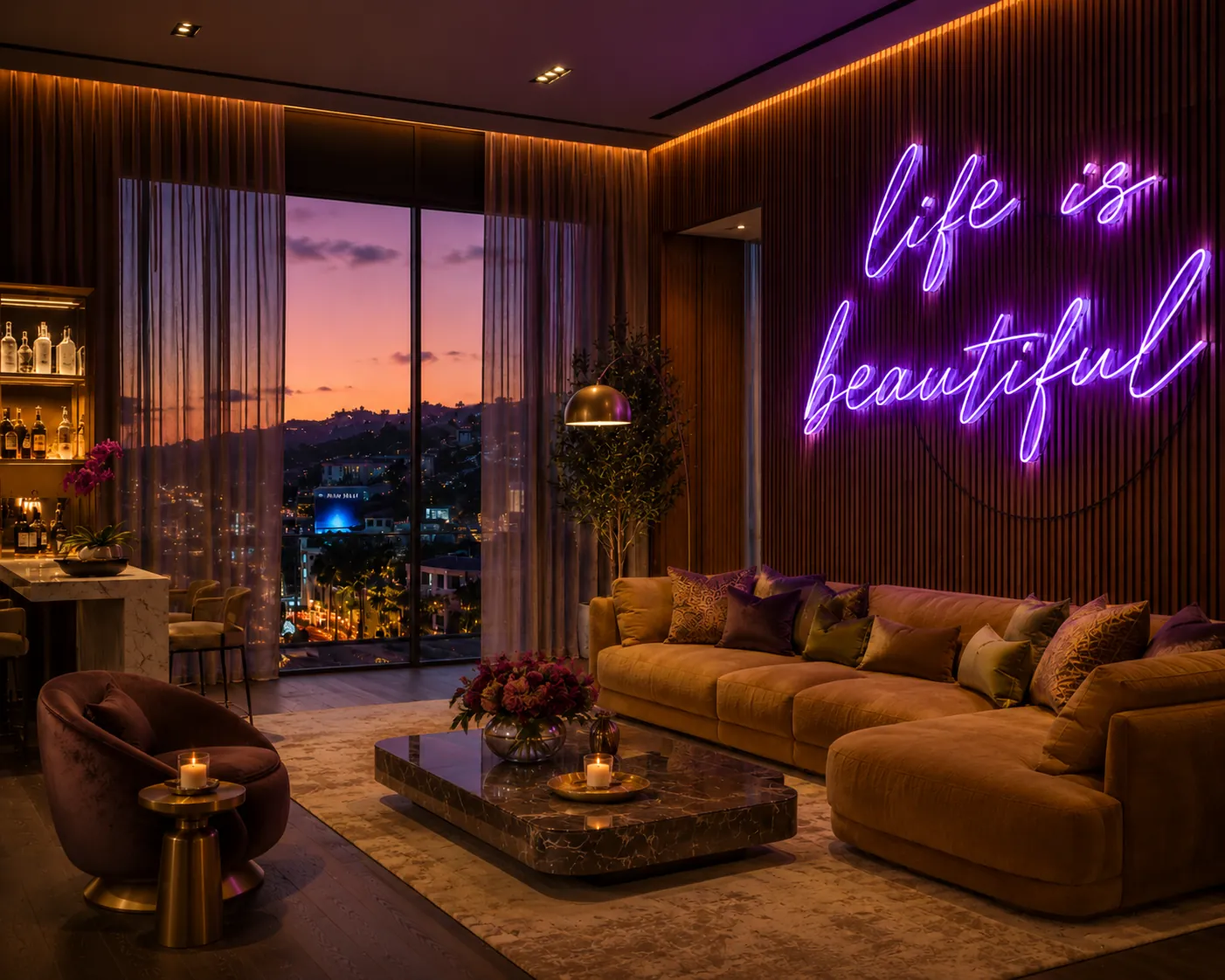
Noise Control and Drapery
Street noise is another question we hear from West Hollywood clients, particularly in residences near active streets and commercial areas.
Drapery does not soundproof a room, and we never present it as a substitute for acoustic windows or architectural soundproofing.
But fabric can contribute to acoustic comfort.
Glass and other hard surfaces reflect sound. Adding substantial textile surfaces can help absorb some reflected sound within a room and make the interior feel softer acoustically.
When acoustic comfort is important, we may consider the relationship between:
- fabric weight
- fullness
- lining or interlining
- layered treatments
- the amount of glass being covered
- the distance and air space between the textile and window
A lightweight decorative sheer and a substantial lined treatment will not behave the same way acoustically.
The construction has to match the objective.
West Hollywood HOA and Condominium Drapery Requirements
Condominium drapery is not designed only from inside the room.
The exterior-facing appearance can matter too.
We have experience working with HOA requirements, and one issue we encounter is the color or appearance of the fabric or lining visible from outside the building.
A beautiful interior fabric may therefore need a lining or construction that creates the appropriate exterior-facing appearance.
We take this into account before fabrication, not after the drapery has been installed.
HOA requirements vary by building, so they should be confirmed for the specific property.
Can an HOA Restrict Drapery?
Yes. Depending on the building, HOA rules can affect aspects of a window-treatment project.
For example, we have encountered requirements involving the exterior-facing appearance of the window treatment.
Some buildings may also have rules that affect mounting, installation procedures or what can be placed on balconies.
In buildings where outdoor drapery is not permitted on balconies, we design the interior treatment around that limitation rather than assuming an exterior textile solution is possible.
We recommend checking the building’s current requirements early in the design process.
Why We Ask About the HOA Before Selecting Fabric
This can save a lot of trouble.
If the HOA requires a particular exterior-facing appearance, we need to know that while we are deciding on the face fabric, lining and overall construction.
Otherwise, a client can fall in love with a fabric before discovering that the finished treatment does not meet the building’s requirements.
For condominium projects, specification and compliance need to work together.
Motorized Drapery for West Hollywood Condos
Motorization can be especially useful for tall windows, wide expanses of glass, layered treatments and windows that are difficult to reach.
It is also useful when a client wants different privacy and light conditions throughout the day.
For example, a sheer layer may remain closed during brighter daytime hours while a blackout or privacy layer operates separately in the evening.
Motorization does not automatically mean opening walls and completely rewiring a residence.
Depending on the system, window, treatment weight and project conditions, rechargeable or battery-powered solutions may be possible.
For larger or new-construction projects, hardwired systems can also be considered during planning.
We specify the system according to the actual drapery and architecture rather than choosing the motor independently from the treatment.
Custom Drapery for West Hollywood Condos and Apartments
Condominiums and apartments often require more careful planning than people expect.
We look at:
- available mounting surfaces
- ceiling conditions
- window and door operation
- stack-back
- adjacent walls
- furniture placement
- balcony or sliding-door access
- HOA requirements
- privacy from neighboring residences
- exterior appearance
- installation access
A few inches can completely change how a finished treatment works.
That is why professional field measuring matters.
Professional Measuring in West Hollywood
We do not measure only the width and height of the glass.
For custom drapery, we may need to document the ceiling, wall conditions, trim, projections, doors, handles, outlets, vents, furniture, stack-back area and the surfaces that will actually support the hardware.
For floor-to-ceiling glass, motorized treatments or concealed tracks, these relationships become even more important.
The goal is to understand the finished installation before the drapery is fabricated.
Choosing Fabric for West Hollywood Drapery
Fabric selection begins with how the room needs to function.
A bedroom requiring strong light control needs a different specification from a living room where preserving the view is the priority.
We consider:
- light exposure
- privacy
- fabric weight
- drape and movement
- fullness
- pleat style
- lining
- durability
- UV exposure
- acoustic objectives
- exterior-facing appearance when an HOA is involved
A beautiful fabric is only the beginning.
How it is constructed determines much of what the client ultimately sees.
Linen Drapery
Linen can work beautifully in West Hollywood interiors because it can move between relaxed and highly tailored depending on its weight, construction and pleat.
In a contemporary residence, linen can soften glass, stone, plaster and other hard architectural surfaces.
For a more tailored treatment, we consider the stability of the fabric, fullness, lining and heading rather than relying on the fiber name alone.
Blackout Drapery for Bedrooms
Blackout is particularly valuable when a bedroom faces street lighting, neighboring buildings or strong morning or afternoon sun.
But blackout is not simply a matter of selecting a fabric labeled “blackout.”
Light can enter around the perimeter of a treatment.
Track position, return, overlap, mounting height and the relationship between the drapery and architecture all affect the final result.
For clients who want a softer appearance during the day, we often consider a sheer layer with a separate blackout treatment.
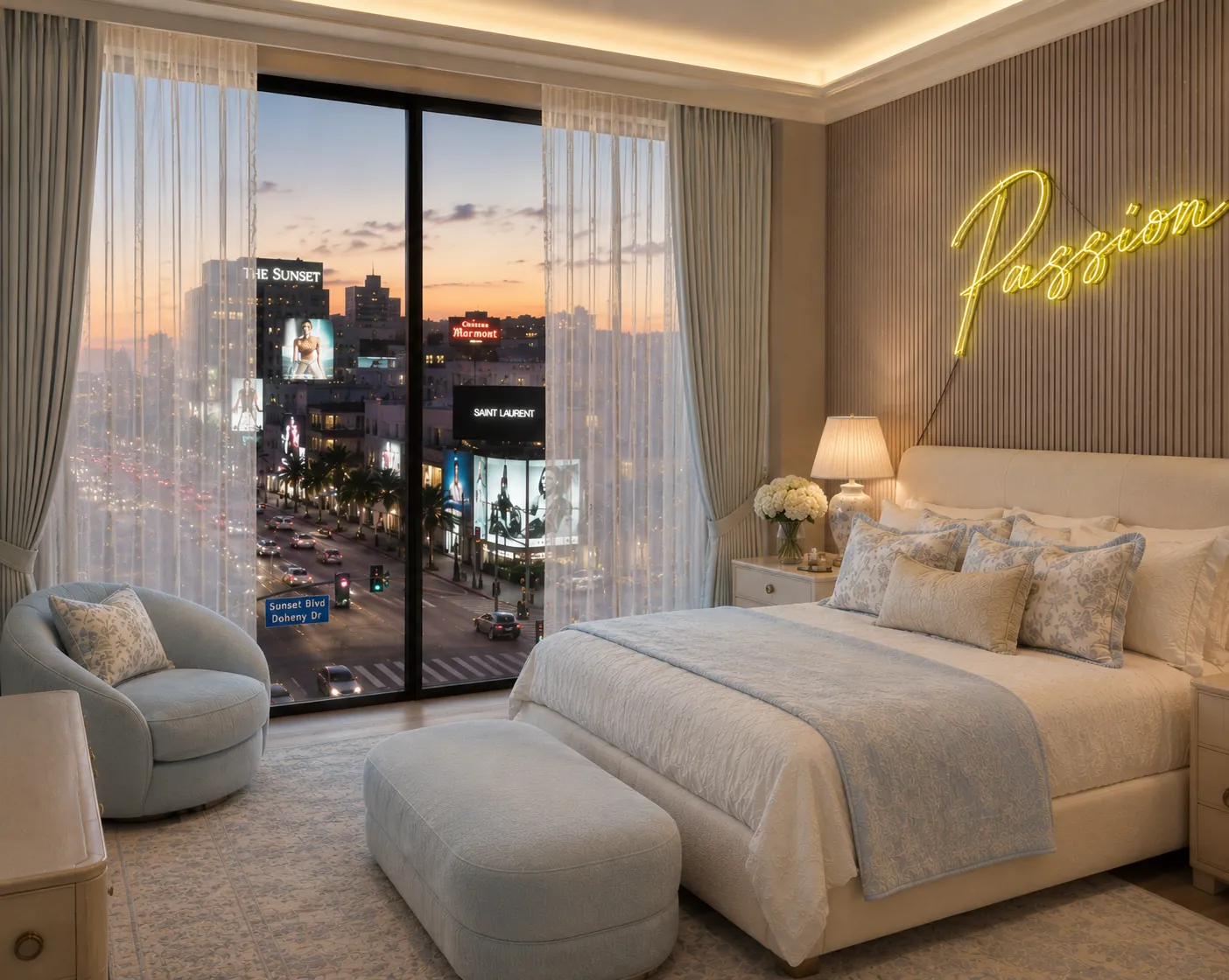
Roman Shades
Not every West Hollywood window needs full-length drapery.
Roman shades can be an excellent choice where wall space is limited, where furniture sits below the window or where a more contained architectural treatment is appropriate.
They can also be combined with drapery when the two treatments have different functions.
The decision depends on the proportions of the window and room rather than following one style throughout the entire residence.
Pleat Style Changes the Architecture of the Drapery
Pleat style affects much more than the top few inches of a curtain.
It changes how the fabric leaves the track or rod, how the folds travel down the panel, how much fullness is required and how the treatment stacks when open.
For West Hollywood interiors, we frequently consider clean, architectural treatments such as ripple fold and tailored pleats, while French pleats can work beautifully where a more structured or classic detail suits the room.
The architecture and fabric should determine the pleat, not a trend.
Fullness Matters
Fullness is the relationship between the width being covered and the amount of fabric used to cover it.
Too little fabric can make drapery look flat and underdeveloped.
Too much can create unnecessary bulk, particularly when the drapery needs to stack beside a valuable view.
The correct fullness depends on the fabric, pleat, track, window width and desired finished appearance.
On large glass openings, fullness and stack-back need to be considered together.
Lining Is Part of the Specification
Lining can change the weight, body, light control, exterior appearance and longevity of a drapery treatment.
That makes it particularly relevant in West Hollywood when we are dealing with strong sun, bedrooms, acoustic comfort or condominium exterior-facing requirements.
But not every drapery requires lining.
Sheers, certain performance fabrics and other treatments may be intentionally unlined.
The right construction depends on what the treatment needs to accomplish.
Custom Curtain Rods, Tracks and Drapery Hardware
Hardware is part of the architecture of custom drapery.
Depending on the project, we can specify or create:
- custom-length rods
- custom finishes
- finials
- brackets
- tracks
- motorized tracks
- curved solutions
- hardware for unusual window conditions
For a concealed modern treatment, the goal may be to make the track visually disappear.
In another room, a decorative rod may be an intentional design element.
We can also prepare drawings and mock-ups when a custom condition requires more detailed planning.
Drapery for Spanish and Art Deco Interiors
West Hollywood is not one architectural style.
Contemporary condominiums sit near older Spanish and Art Deco residences, and the same drapery treatment should not automatically be applied to all of them.
In a Spanish interior, we may want more texture, softness or a relationship with decorative hardware and architectural detailing.
In an Art Deco setting, proportion, tailoring, geometry and material can become more important.
Contemporary interiors may call for quieter hardware and cleaner vertical lines.
Our goal is not to make the drapery announce a style.
It is to make it feel as though it belongs to the room.
Three West Hollywood Design Conditions We See Repeatedly
Sunset Strip Condominiums and Large Glass Corners
Large glass corners can require careful coordination between the sheer layer, privacy or blackout treatment, track layout, stack-back and motorization.
The challenge is controlling light and privacy without unnecessarily covering the view.
Art Deco and Character Apartments
Older apartments can call for a completely different approach.
Fabric, pleat style and hardware need to relate to the proportions and character of the architecture while still solving modern requirements such as privacy and light control.
Contemporary Lofts and Minimal Interiors
In a more minimal interior, every visible detail matters.
A concealed track, tailored panel and carefully selected textile can soften concrete, glass and hard surfaces without adding unnecessary decoration.
Working With Interior Designers, Architects and Builders
We work directly with homeowners as well as interior designers, architects and builders.
For trade and renovation projects, drapery should be considered early enough to coordinate mounting, recesses, electrical requirements, ceiling details and finished dimensions.
Waiting until the end of construction can limit what is possible.
We can review plans, discuss fabric and hardware specifications, prepare drawings where appropriate and coordinate field measurements before fabrication.
Fabric Resources and the Pacific Design Center
Our relationship with West Hollywood also gives us access to an extensive design community.
We work with fabric brands and showrooms at the Pacific Design Center as part of our sourcing process when appropriate for a project.
House of Drapery does not maintain a studio or showroom inside the Pacific Design Center.
Fabric selection can take place through private consultation, in the client’s home, through appropriate showroom resources or by appointment depending on the project.
A 14-Year Duroque Presence in West Hollywood
House of Drapery by Duroque builds on a long relationship with West Hollywood.
Duroque had a 14-year presence in West Hollywood, while our design experience extends for more than 20 years.
That history matters because custom drapery sits at the intersection of interior design and technical fabrication.
We are not simply selecting curtains.
We are looking at how textile, proportion, light, architecture and function come together in the finished room.
Private West Hollywood Office by Appointment
House of Drapery by Duroque maintains a private office and meeting space at 8335 Sunset Blvd, Suite 323, West Hollywood.
It is not a public showroom or walk-in retail store.
Meetings are by appointment.
For drapery projects, we generally prefer to evaluate the actual residence because seeing the windows, exposure, architecture, furniture and mounting conditions gives us information that cannot be obtained from measurements alone.
Initial conversations can also take place by phone or virtually before an in-home consultation is scheduled.
From Consultation to Installation
Our process is designed to keep design and execution connected.
We begin by understanding the room, the client’s priorities and the problems the window treatment needs to solve.
From there we can coordinate:
- consultation and design direction
- professional field measuring
- fabric and lining selection
- pleat and fullness specification
- hardware and track specification
- motorization where appropriate
- fabrication through our custom drapery workroom
- professional installation
- steaming, dressing and final review as appropriate to the project
The details are supervised as part of one design process rather than treating the fabric, hardware and installation as unrelated decisions.
Custom Drapery Should Solve the Room
The most successful drapery does not begin with a trend.
It begins with the room.
In West Hollywood, that may mean preserving a Sunset view while gaining nighttime privacy. It may mean reducing glare across a wall of glass. It may mean working within an HOA’s exterior-facing requirements or adding textile softness to a room affected by street noise.
The solution may be a sheer, blackout drapery, Roman shade, solar shade, motorized layered treatment or a combination of several systems.
The objective is the same:
make the window treatment feel intentional, functional and completely connected to the architecture.
Frequently Asked Questions About Custom Drapery in West Hollywood
Do you provide custom drapery throughout West Hollywood?
Yes. House of Drapery by Duroque provides custom drapery and window-treatment design, measuring, fabrication and installation for West Hollywood residences, including condominiums, apartments and homes.
Do you have a showroom in West Hollywood?
We have a private office and meeting space at 8335 Sunset Blvd, Suite 323, but it is not a public showroom or walk-in retail location. Meetings are by appointment. For drapery projects, in-home consultation is often more useful because we can evaluate the windows and architecture directly.
Do you work with West Hollywood HOAs?
Yes. We have experience with condominium and HOA requirements. Requirements vary by building, but exterior-facing fabric or lining color can matter, and some properties may have additional rules affecting mounting, installation or balcony treatments. We recommend confirming the property's current requirements before final specification.
Why does the outside color of my drapery matter in a condominium?
Some condominium associations regulate the appearance of windows from the exterior so the building maintains a consistent facade. In those situations, lining or another exterior-facing layer may need to meet the building's requirements even when the decorative face fabric is a different color.
Can I install outdoor curtains on my West Hollywood balcony?
That depends on the building. We have encountered condominium properties where outdoor drapery on balconies is not permitted. The current HOA rules should be confirmed before designing an exterior treatment.
Can drapery help with street noise?
Drapery can contribute to acoustic comfort by adding soft, absorptive textile surfaces to a room, particularly when substantial fabric, fullness, lining or layering is used. It does not soundproof the room or replace acoustic windows.
What window treatments are best for privacy in a West Hollywood condo?
It depends on the exposure and neighboring buildings. A common solution is layered window treatments, with sheer drapery for filtered daytime light and a separate privacy or blackout treatment for nighttime.
Can I keep my view and still have privacy?
Often, yes, particularly during the day. The correct sheer can soften visibility while preserving much of the exterior view. Nighttime privacy usually requires a more opaque second layer because interior lighting changes visibility through sheer fabric.
What works best for strong afternoon sun?
Depending on the window and design, we may consider performance sheers, lined drapery, solar shades, blackout treatments or layered systems. Exposure, heat, glare, UV concerns and view preservation should all be considered together.
Do you provide motorized drapery in West Hollywood?
Yes. Motorization can be particularly useful for tall windows, wide glass openings and layered treatments. Depending on the project, rechargeable/battery-powered or hardwired systems may be considered.
Can motorized drapery be installed without opening the walls?
Sometimes. Rechargeable or battery-powered motorized systems can make retrofit motorization possible in certain conditions. The appropriate system depends on the size and weight of the treatment, hardware and project requirements.
Do you make custom curtain rods and hardware?
Yes. We can provide custom lengths, finishes, finials, brackets, curved solutions and other custom hardware depending on the project. Drawings and mock-ups can also be prepared for more specialized conditions.
Do you provide professional measuring and installation?
Yes. Professional field measuring and installation are part of our custom drapery process. We evaluate more than the glass dimensions because mounting surfaces, ceiling conditions, stack-back and surrounding architecture affect the finished treatment.
Do you work with interior designers and architects?
Yes. We work with homeowners, interior designers, architects and builders and can coordinate fabric, hardware, measuring, fabrication, motorization and installation as part of the larger project.
How do I start a West Hollywood drapery project?
Start with a private consultation. We can first discuss the project by phone or virtually and then determine the appropriate next step, which may include an in-home consultation and field measurement.
Schedule a Private Consultation
If you are planning custom drapery or window treatments for a West Hollywood home, condominium or apartment, we can look at the windows, privacy, light, architecture and building requirements together and determine the right solution.
Schedule a Private ConsultationRecent custom drapery and curtain work in West Hollywood from the studio archive — Beverly Hills Estate Window Treatments, Pacific Palisades Master Bedroom — Monogrammed Linen Cornices, and West Hollywood Residence — Sunset Strip Sheer & Acoustic Blackout. For the underlying specification, see Custom Sheer Drapery in Los Angeles, and Custom Motorized Drapery in Los Angeles. For investment ranges by room and tier, see the 2026 Pricing Guide.