For Designers, Trade Professionals & Residential Projects

Drapery Workroom & Custom Drapery Fabrication in Los Angeles

House of Drapery by Duroque provides designer-led custom drapery fabrication and workroom services for projects throughout Los Angeles. We work with interior designers, trade professionals and private residential clients on projects ranging from qualified fabrication-only assignments to complete custom drapery programs.

Already have fabric, specifications or a project in development? We can evaluate the project and determine the appropriate scope, whether that means fabrication, field measuring, installation or a complete design-to-installation service.

A Window Treatment Workroom Is More Than a Sewing Service

When people search for a window treatment workroom, they are often looking for the place where a drapery concept becomes a finished treatment.

But successful custom drapery fabrication involves considerably more than sewing fabric to a specified length.

The finished result is affected by measurements, fabric characteristics, fullness, heading construction, lining, hardware, stack-back, returns, finished length, pattern placement and installation conditions. On more complicated projects, the fabrication also has to work with architectural conditions, recessed tracks, motorization and construction sequencing.

House of Drapery approaches the workroom process from a designer's perspective.

The objective is not simply to produce a curtain. It is to understand what the finished treatment is supposed to look like, how it is supposed to hang and move, and what needs to happen during specification and fabrication to achieve that result.

For some projects, House of Drapery is involved from the initial design consultation through installation and final dressing. For others, an interior designer may already have developed the design and selected the fabric and needs an experienced partner to help execute the treatment — the same discipline behind all of our custom drapery.

The scope depends on the project.

Trade & Fabrication

Have a Drapery Project Ready to Discuss?

Send the project information you already have, including specifications, measurements, fabric information, drawings or photos where available.

Drapery Workroom Services for Interior Designers and the Trade

Interior designers do not always need another designer. Sometimes they need a capable fabrication and execution partner.

A designer may already know the intended treatment, have selected the fabric and established the aesthetic direction. What remains is translating that design into a finished drapery treatment that works with the actual windows, hardware and room.

House of Drapery can evaluate qualified trade projects at different stages of development.

Depending on the scope, we may assist with field measuring, fabrication planning, workroom coordination, hardware considerations, installation and final dressing.

Designers may also provide their own fabric. Before fabrication, the material should be evaluated in relation to the proposed treatment because not every fabric behaves the same way when used for full-height drapery, structured pleats, ripple fold, sheers or lined treatments.

For qualified projects where the design and specification are already established, fabrication-only service may also be considered.

Fabrication-only projects are reviewed individually, and not every project is accepted.

This allows House of Drapery to determine whether the specification, fabric, measurements and project conditions are appropriate before accepting responsibility for fabrication.

Have a Project Ready for Fabrication?

Send us the project location, specifications, fabric information, drawings or photographs you already have. We can review the scope and determine the appropriate next step.

Four Ways We Can Enter a Drapery Project

Not every project arrives at the workroom at the same stage.

Fabrication Only

For qualified trade projects where the design direction, fabric and necessary specifications have already been established, House of Drapery can evaluate the project for fabrication-only service.

Before accepting the project, we need enough information to understand what is being fabricated and whether the supplied specification is workable.

Measuring + Fabrication

A designer may have established the design and selected the material but want field measurements verified before fabrication.

This can be particularly important for floor-to-ceiling drapery, multiple openings, uneven conditions or projects where finished length and hardware placement leave little tolerance for error.

Fabrication + Installation

Some projects arrive with a developed specification but require both fabrication and professional installation.

The relationship between fabrication and installation matters because the finished treatment has to work with the actual track or rod, mounting condition, floor and ceiling dimensions and intended draw.

Full-Service Custom Drapery

For clients who need the entire process managed, House of Drapery can oversee the project under designer supervision:

Consultation → measuring → drawings/specification → fabric → fabrication → hardware → installation → steaming and dressing → relevant trade coordination

For motorized projects, that process may also involve coordination with the electrician and smart-home integrator.

Custom Drapery Fabrication Begins With the Specification

Beautiful fabric does not correct an incomplete specification.

Before fabrication begins, the workroom needs to understand what the treatment is supposed to become.

That includes the finished dimensions, treatment style, heading or pleat, fullness, lining condition, hardware relationship, returns and overlaps where applicable, and how the treatment is expected to operate.

For a straightforward decorative panel, the specification may be relatively simple.

For a wall of floor-to-ceiling drapery, layered sheers and blackout treatments, large-scale pattern, or motorized installation, considerably more coordination may be necessary.

This is why House of Drapery treats drapery fabrication as part of the larger design and installation process rather than as an isolated sewing operation.

A decision made at the beginning can change how the finished drapery looks at the end.

Measuring for Drapery Fabrication

Accurate fabrication starts with accurate information.

A workroom needs more than a rough window width and ceiling height.

Depending on the treatment, measurements may need to account for the actual hardware location, finished drapery length, floor condition, ceiling condition, returns, overlaps, stacking direction and the relationship between multiple treatments.

For existing homes, the physical conditions can be field verified.

For projects still under construction, drawings may help establish design intent, but final fabrication dimensions may still depend on what is actually built.

This distinction becomes particularly important when drapery is intended to align precisely with architecture or when tracks are recessed into the ceiling.

For qualified projects, House of Drapery can evaluate whether supplied measurements are sufficient or whether professional field measuring is appropriate before fabrication proceeds.

Fabric Selection and Fabric Suitability

A fabric can be beautiful on a memo sample and still be wrong for the intended drapery treatment.

Weight, body, width, transparency, repeat, texture and the way a material folds can all affect the finished result.

A sheer intended to filter daylight behaves differently from a heavier decorative textile. A structured pleat creates different demands than a soft treatment. A large pattern may need careful placement across multiple widths.

This is why fabric selection should be considered together with the treatment rather than as an independent decorative decision.

Interior designers and clients are welcome to provide their own fabric for appropriate projects. Before fabrication, House of Drapery evaluates the material in relation to the proposed treatment and project requirements.

Where House of Drapery is providing full-service design, fabric can also be selected as part of the overall drapery specification.

Fullness Changes the Amount of Fabric — and the Finished Architecture

Fullness is one of the decisions that separates custom fabrication from simply covering an opening with fabric.

Too little fullness can leave drapery looking flat and under-scaled. More fullness creates greater depth and fabric volume, but it also affects yardage, stacking and the amount of physical space the finished treatment occupies.

There is no single fullness percentage that is correct for every project.

The right amount of drapery fullness depends on the treatment, fabric, heading, hardware and desired appearance.

This becomes especially important on large windows and walls of glass, where a seemingly small specification change can translate into a substantial amount of additional fabric.

Pleats and Headings Are Part of the Fabrication

Pleats are not simply decoration at the top of a drape.

They control how fabric is organized across the treatment and strongly influence how the drapery falls vertically.

French pleats can create a more tailored, dimensional rhythm. Ripple fold creates a continuous wave and has a very different relationship with its track and carrier system. Other heading styles can create softer, flatter or more architectural effects.

The heading therefore needs to be considered with the fabric, fullness, hardware and intended room, which is why pleats and headings are specified alongside everything else.

House of Drapery works with the specified treatment rather than forcing every project into the same construction method.

Floor-to-ceiling French pleat drapery spanning a large Los Angeles great room beside a low sofa and lounge chair.
Project Evidence — Reseda Great RoomA Los Angeles great room project used full-height French pleat drapery to frame a large opening while maintaining the scale required by the architecture. The finished treatment demonstrates how heading construction, fabric volume, mounting height and installation work together as one composition.

Lining Is Part of the Finished Treatment

Lining can influence opacity, light control, body, privacy and how the face fabric presents in the room.

But lining should not automatically be treated as an upgrade that every drapery requires.

Some fabrics and applications benefit from lining. Others, particularly sheers, are intended to transmit light and are designed differently.

For bedrooms and other rooms requiring substantial light control, blackout drapery construction may become part of the specification.

The correct approach depends on what the finished treatment needs to accomplish.

Sheer Drapery Requires Its Own Fabrication Decisions

Sheer drapery looks visually light, but it still requires careful specification.

The material, fullness, seam strategy, finished length and track relationship affect whether the treatment feels refined or simply transparent.

Sheer drapery can be used independently or layered with a second drapery treatment for greater privacy and light control.

When two treatments occupy the same window, their combined physical depth must also be considered. This becomes especially important when tracks are concealed or recessed into architectural pockets.

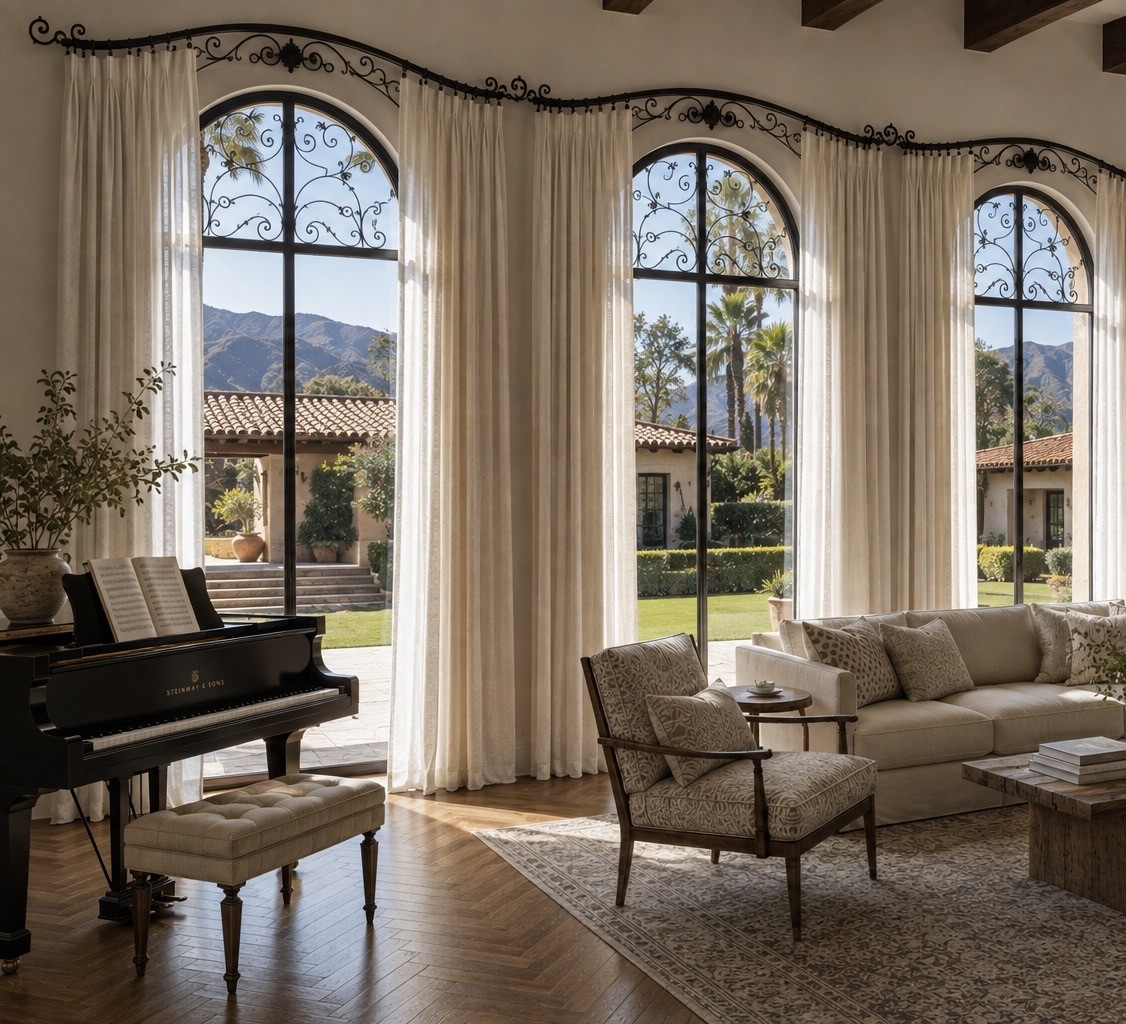
Living room with three tall arched windows and floor-length ivory sheer drapery beside a grand piano.
Project Evidence — Santa BarbaraA Santa Barbara project using full-height drapery and sheer treatments demonstrates the role of scale, layering and daylight in the finished window composition.

Fabricating Drapery for Large Windows and Walls of Glass

Large openings amplify specification mistakes.

A treatment spanning a wall of glass can involve many fabric widths, substantial finished weight and a significant stack when open.

That means fabrication cannot be considered independently from the architecture and hardware.

Before fabrication, questions may include:

  • How much fabric is required to achieve the intended fullness?
  • Where will the drapery stack when open?
  • Will the stack interfere with the view or doorway?
  • Can the hardware carry the finished treatment?
  • Is a center opening or one-way draw more appropriate?
  • Will manual operation be practical?
  • Does the ceiling condition support the intended track?

These are design and engineering relationships that need to be resolved before the finished drapery is hanging in the room.

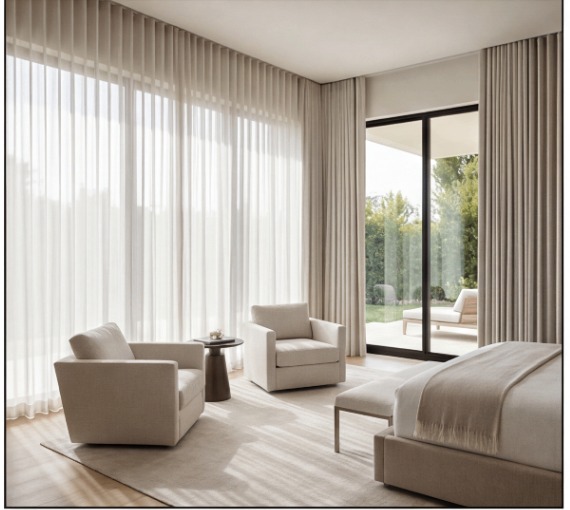
Primary suite with full-height drapery beside large sliding glass doors opening to a garden terrace.
Project Evidence — Beverly HillsIn a Beverly Hills primary suite, full-height drapery was designed in relationship to a broad glazed opening and garden view. The project demonstrates why fabric volume, stack-back, track placement and the architecture should be considered together.

Motorized Drapery Has to Be Designed Before It Is Fabricated

Motorization is not something that should simply be added after a conventional drapery treatment has already been fabricated.

The track, carrier system, fabric weight, fullness, stack-back, draw direction, ceiling condition and power strategy all influence the finished system.

On new construction and major remodels, House of Drapery can coordinate the drapery requirements with the relevant contractor, electrician and smart-home integrator.

For existing homes, rechargeable motorization may offer an alternative where opening finished walls for hardwired power would be impractical.

The workroom's responsibility is the finished treatment. Programming and commissioning of the broader smart-home system are coordinated with the appropriate integrator.

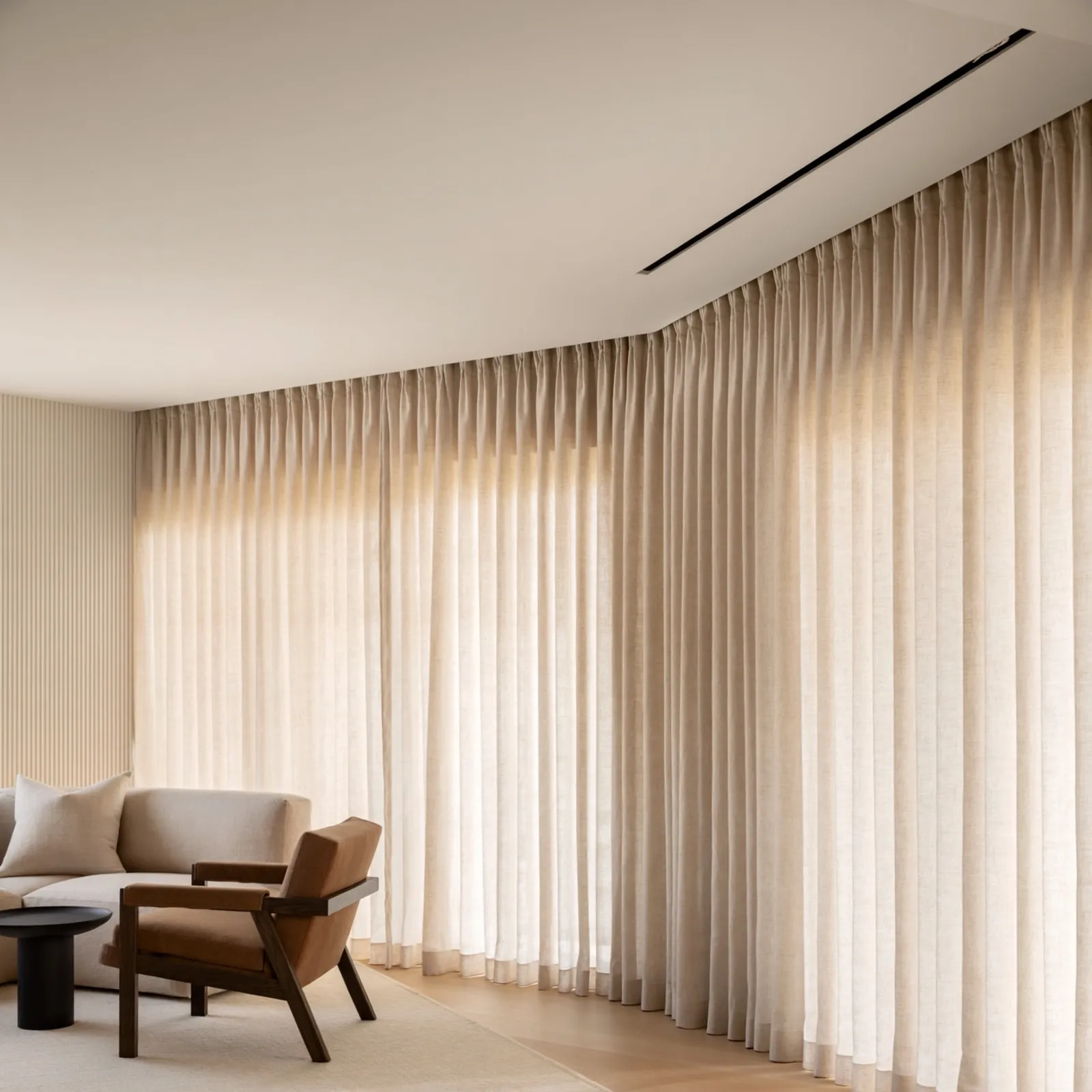
Bedroom with ceiling-mounted ripple fold drapery drawn across a wide window wall.
Project Evidence — MalibuA Malibu bedroom with ripple fold drapery, where the continuous wave depends on the relationship between track, carrier spacing, fullness and finished fabric.

A Real Construction Problem: When the Drapery Pocket Is Too Small

One of the most expensive drapery problems can happen before the drapery is ever fabricated.

On a recent Glendale-area project, House of Drapery was preparing layered motorized drapery using double Lutron tracks: a sheer treatment plus the primary ripple-fold drapery.

Before installation, we identified that the recessed/drop-ceiling condition provided only approximately four inches of usable pocket depth, with roughly two inches between the two tracks.

That was not sufficient for both finished fabric layers to operate properly at the intended fullness.

The issue illustrates an important point: a ceiling pocket has to accommodate the finished drapery, not merely the physical track.

For layered sheer plus regular motorized drapery, House of Drapery generally recommends evaluating substantially more usable clearance. Based on our project experience, approximately 8–9 inches of usable space can be an appropriate planning starting point for some double-treatment conditions, but the required dimension must be determined for the actual tracks, fabrics, fullness and project.

This is a House of Drapery studio recommendation based on project experience, not a universal Lutron specification.

Early coordination can prevent a finished ceiling from having to be reconsidered after the motorized tracks and fabric are ready.

Professional Installation Completes the Fabrication

Fabrication does not end when the finished drapery leaves production.

Installation is where the treatment meets the actual architecture.

Track elevation, bracket placement, carrier configuration, finished length and floor relationship can affect the final appearance. After hanging, drapery may also require steaming and dressing so the folds settle into the intended rhythm.

For projects where House of Drapery provides installation, the objective is continuity between what was specified, what was fabricated and what is ultimately seen in the room.

Qualified fabrication projects may therefore include professional drapery installation depending on scope and location.

Quality Control Is About the Entire Finished Treatment

Quality in custom drapery is not defined by one seam.

It is the relationship between many details.

  • Does the treatment finish at the intended length?
  • Does the heading behave correctly on the specified hardware?
  • Does the fullness create the intended proportion?
  • Do multiple panels relate properly to one another?
  • Does the fabric hang as expected?
  • Does the treatment open, close and stack properly?
  • Does the finished installation look intentional in the room?

House of Drapery oversees the fabrication process in relation to the approved project scope and finished design intent.

For us, the objective is not merely to have something made. It is to deliver a finished treatment that belongs in the architecture for which it was designed.

A note on construction

The hem is the shoe of the drapery

In the studio's professional opinion, the hem is one of the defining indicators of luxury custom drapery. For most floor-length panels our specification calls for a 4-inch double-fold hem with approximately 8 inches of fabric allowance and, on lightweight cloths and tall panels, a concealed bottom weight chain sewn into the hem. Where the fabric requires it — sheers, organza, fine silks — alternative techniques (blind stitch, slip stitch, fine rolled / Euro hem) are specified instead. Industry standards are professional starting points; construction is specified to the fabric, not duplicated from the last project. Construction decisions of this kind are personally specified by Olga Rechdouni, ASID.

Read Chapter V.1 — The Hem →

Residential, Trade and Hospitality Drapery Fabrication

The workroom process changes according to the project.

A private residence may require detailed coordination between the homeowner, designer and installer.

A trade project may arrive with an established design specification and selected fabric.

A hospitality or commercial project may involve multiple openings, repeated treatment types, schedules, construction sequencing and coordination with other trades.

House of Drapery evaluates each project according to its scale, specification, location and required services.

For larger commercial and hospitality scopes, see our dedicated commercial program.

What Information Should You Send for a Fabrication Quote?

The more developed the project information, the easier it is to understand the intended scope.

For a trade or fabrication inquiry, send whatever is already available.

Useful information may include:

  • project location
  • number of windows or treatments
  • approximate or verified dimensions
  • treatment style
  • drawings or specifications
  • fabric information
  • photographs of the windows
  • hardware information
  • whether fabric has already been selected or purchased
  • whether measuring is required
  • whether installation is required
  • project stage and desired timing

You do not need to have every answer before contacting us.

If the project is appropriate for House of Drapery, we can identify what additional information is needed before fabrication can proceed.

Trade / Fabrication Inquiry

Have a Drapery Project Ready for Review?

Interior designers and trade professionals: send us your available specifications, drawings, photographs and fabric information.

Residential clients: if you need the complete process, request a private consultation and we can begin with the room, architecture and functional requirements.

Please provide either an email address or a phone number.

Project Detail (optional)

Optional. PDF or image (JPG, PNG, WebP). Up to 8 files, 10 MB each. Files are reviewed privately by the studio.

Project information is reviewed by the studio. By submitting, you consent to House of Drapery contacting you about your project.

What Determines the Cost of Custom Drapery Fabrication?

There is no meaningful single price for custom drapery fabrication because the scope can vary dramatically.

Cost may be affected by:

  • treatment size
  • number of fabric widths
  • fabric characteristics
  • pattern repeat and placement
  • heading construction
  • fullness
  • lining
  • treatment complexity
  • hardware relationship
  • motorization
  • measuring requirements
  • installation
  • project scale
  • location and site conditions

A fabrication-only trade project is also fundamentally different from a complete residential program that includes design, fabric sourcing, hardware, measuring and installation.

For that reason, House of Drapery evaluates the actual project before establishing the appropriate scope and pricing.

FAQs · Drapery Workroom Los Angeles

Drapery Workroom Los Angeles — Frequently Asked Questions

What does a drapery workroom do?

A drapery workroom translates a window-treatment specification into a finished fabric treatment. Depending on the project, that may involve evaluating measurements, fabric, fullness, heading construction, lining, finished dimensions and the relationship between the drapery and its hardware. House of Drapery manages this process in relation to the overall design and approved project scope.

What is a window treatment workroom?

A window treatment workroom is a fabrication resource for custom window treatments. In drapery projects, the workroom is where specifications for fabric, dimensions, heading style, fullness and other construction details are translated into the finished treatment.

Do you work with interior designers?

Yes. House of Drapery works with interior designers and other trade professionals on qualified Los Angeles projects. The appropriate scope can range from measuring and fabrication to fabrication plus installation or complete project execution.

Can an interior designer provide their own fabric?

Yes. Designers may provide their own fabric for appropriate projects. The fabric should be reviewed in relation to the specified treatment before fabrication because material characteristics can affect construction and finished appearance.

Do you accept fabrication-only projects?

Qualified fabrication-only projects may be considered when the design, specifications, measurements and fabric information are sufficiently developed. Projects are evaluated individually, and not every fabrication-only project is accepted.

Can you fabricate from measurements supplied by a designer?

Supplied measurements can be reviewed as part of the project information, but whether they are sufficient for fabrication depends on the treatment and site conditions. House of Drapery may recommend field verification before fabrication where finished dimensions are critical.

Can you measure and then fabricate the drapery?

Yes, measuring and fabrication can be included within the project scope when appropriate.

Can you fabricate and install custom drapery?

Yes. Qualified projects can include both custom drapery fabrication and professional installation, allowing the fabricated treatment to be coordinated with the actual hardware and architectural conditions.

Do you fabricate custom curtains as well as drapery?

The words curtains and drapery are often used interchangeably by homeowners. House of Drapery specializes in professionally specified custom fabric window treatments. For Los Angeles consumers researching custom curtain terminology and services, see our Custom Curtains Los Angeles page.

Can a drapery workroom fabricate motorized drapery?

Yes, but the fabric treatment must be specified in relation to the motorized track and operating conditions. Fabric weight, fullness, stack-back, carrier system and available architectural space can all matter.

What should be specified before drapery fabrication begins?

Depending on the treatment, the workroom may need finished dimensions, fabric information, heading style, fullness, lining requirements, hardware information, draw direction and other construction details. More complex projects may require additional coordination.

Do you provide drapery alterations or small curtain repairs?

House of Drapery is focused on new custom drapery fabrication and complete window-treatment projects rather than small alteration or repair services.

Do you work on hospitality or commercial drapery projects?

House of Drapery evaluates hospitality and commercial projects as well as residential and trade work. Larger commercial projects may involve repeated treatment types, schedules and coordination with construction and installation teams.

How do I request a drapery fabrication quote?

Send the project location and whatever information you already have, such as window dimensions, specifications, fabric information, photographs, plans and whether measuring or installation is required. House of Drapery can review the project and determine the appropriate next step.

Begin

Begin a Workroom or Custom Drapery Project

Whether you are an interior designer with an established specification or a homeowner who needs the complete process, the first step is understanding the project.

For trade inquiries, send us the information already available. We can evaluate whether the project is appropriate for fabrication-only service, measuring and fabrication, fabrication plus installation, or broader project coordination.

For residential projects, House of Drapery can oversee the process from the initial design decisions through fabrication and installation, the same standard applied to custom drapery in Los Angeles.

Informed by the Design Standards

The reasoning behind this work

Workroom decisions — header, hem, interlining, weighting — follow from the brief the consultation produced and are specified chapter by chapter in the Design Standards.

Continue the Conversation

Ready to design your windows the way the room deserves?

Begin with a private consultation. We will follow with a tailored proposal, fabric direction, and an honest opinion on what your room is asking for.

  • Complimentary initial consultation
  • Olga personally reviews every project
  • Design, fabrication & installation under one coordinated process
  • No obligation
CallTextSchedule