
- 20+ Years of Design Experience — Olga Rechdouni, ASID
- ASID Professional Member
- Custom Design · Fabrication · Installation
- Luxury Homes Throughout Los Angeles
Custom Drapery Designed From Fabric to Installation
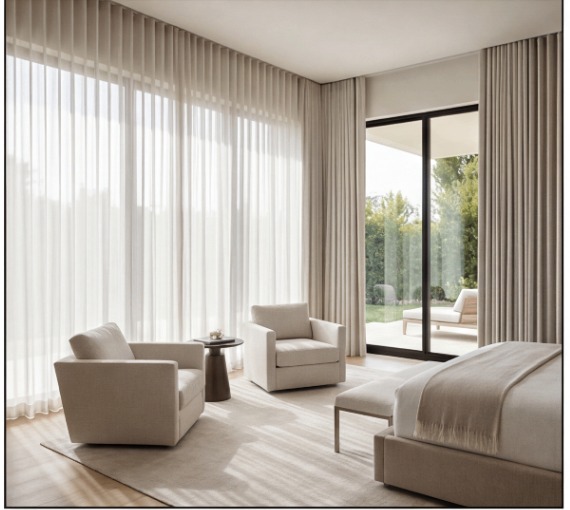
Custom drapery and designer draperies are more than fabric made to fit a window. Whether a project calls for tailored drapes, full-height curtains, layered sheers or completely custom window treatments, the way the finished drapery looks, hangs, moves and performs depends on decisions made long before fabrication: the architecture of the room, window dimensions, fabric weight, fullness, pleat style, lining, hardware, stack-back, mounting conditions and how the finished panels will be used.
At House of Drapery by Duroque, custom draperies are developed under designer supervision from the initial concept through measuring, specification, fabrication and final installation. We approach the window as part of the interior rather than as a separate decorative element.
That distinction becomes especially important with large windows, tall ceilings, walls of glass, layered sheers and draperies, blackout requirements, concealed tracks and motorized systems. A beautiful fabric alone cannot compensate for incorrect proportions or poorly planned hardware.
The goal is not simply to make curtains. It is to create drapery that belongs in the room.
What Is Custom Drapery?
Custom drapery is made specifically for an individual window, room and design rather than manufactured in predetermined retail sizes.
The process allows the finished treatment to be designed around the actual architecture. Width, finished length, fullness, header construction, pleat style, fabric placement, lining, return, overlap, stack-back and hardware can all be specified for the project.
The words drapery, draperies, drapes and curtains are often used interchangeably by homeowners. In professional interior design, however, custom drapery generally describes a more fully specified treatment in which the fabric, fabrication and hardware are considered together.
This is why two rooms using the same fabric can produce completely different results. The difference may be the fullness, heading, lining, track placement, finished length or simply how much room was allowed for the drapery to stack when open.
Custom Drapes, Curtains or Draperies: What Should You Ask For?
Clients use all three terms. You may search for custom drapes, custom curtains or custom draperies, but the terminology matters less than the specification.
A truly custom treatment is designed around the actual window and room. Fabric, finished dimensions, fullness, heading, lining, hardware, stack-back and installation all affect the result.
For a tailored interior, the objective is not simply to choose the right word. It is to design a window treatment specifically for the architecture, natural light, privacy requirements and the way the room will be used.
Why Custom Draperies Look Different From Ready-Made Curtains
Ready-made curtains are designed to work within standardized dimensions. Custom draperies begin with the room.
That gives a designer control over details that strongly affect the finished appearance.
A custom panel can be proportioned to the ceiling height, aligned with architectural elements, fabricated for a specific track or rod and designed to clear furniture, doors or adjacent glass. Pattern placement can be considered before cutting. Fullness can be adjusted for the fabric rather than selected from a generic formula.
Lining can change the body of a fabric. Interlining can add structure and softness. The pleat determines how the drapery leaves the header and falls toward the floor.
Even the amount of fabric hidden at the side of the window when the treatment is open can affect the entire room.
Good custom drapery should look intentional both open and closed.
Designer Draperies Begin With the Room, Not the Fabric
One of the most common mistakes in window treatments is selecting a beautiful fabric first and trying to solve the technical details afterward.
We prefer to start with the room.
How much natural light enters the space? Is privacy needed during the day, at night, or both? Does the client want the window completely exposed when the drapery is open? Is there enough wall area for stack-back? Is the treatment decorative, functional or both? Will it be opened manually every day? Does the room require blackout? Is the ceiling construction suitable for the intended hardware?
Only then should the fabric and fabrication be finalized.
This is the value of designer-led custom drapery. Aesthetic decisions and technical decisions are made together rather than handed from one trade to another after the design has already been established.
Fabric Selection Changes Everything
Fabric is one of the most visible elements of drapery, but appearance is only part of the specification.
Linen, wool, silk, cotton, velvet, sheers and performance textiles behave differently. Weight, weave, fiber content, width, pattern repeat and dimensional stability can affect fabrication and the way the finished drapery hangs.
A lightweight linen may create a relaxed movement that would be impossible to reproduce with a heavy velvet. A sheer intended to soften daylight requires a different approach from a lined decorative drapery intended primarily for evening privacy.
For some projects, a wide-width fabric can reduce vertical seams. For others, traditional widths are appropriate and seams become part of normal workroom fabrication.
We evaluate fabric not simply by how it looks on a memo sample, but by what we are asking that fabric to do at the window.
Fullness Determines the Character of Drapery
Fullness is the relationship between the amount of fabric used and the finished width of the treatment.
It is one of the most important decisions in custom drapery.
Too little fullness can make a treatment look flat or under-scaled. Excessive fullness can create unnecessary bulk, interfere with stack-back or become difficult within a constrained ceiling pocket.
There is no single fullness ratio that is correct for every drapery.
The appropriate amount depends on the fabric, pleat or heading, scale of the window, desired appearance, available stacking space and hardware.
This becomes particularly important with ripple-fold drapery, where the relationship among carrier spacing, fabric fullness, track position and available depth affects the finished wave.
We determine fullness as part of the overall design rather than treating it as an isolated workroom calculation.
Pleats and Headings Create the Architecture of the Fabric
Pleats are not simply decorative details at the top of a curtain.
They determine how the fabric is organized across the track or rod and influence how it falls through the entire height of the treatment.
French pleats can create a tailored traditional appearance. Ripple fold produces a continuous architectural rhythm well suited to contemporary interiors and large expanses of glass. Inverted, tailored and other custom headings can produce very different visual effects.
The right pleat depends on the room, fabric, hardware and desired movement.
A heading that looks beautiful in a photograph may not be appropriate for every installation. The designer has to consider how it will stack, how much projection it requires and how the fabric behaves below it.
Lining Is Part of the Design
Lining is often treated as an accessory. In custom fabrication, it can be fundamental to the performance and appearance of the drapery.
Depending on the project, lining may contribute to privacy, light control, body and protection of the face fabric.
Blackout lining can be useful in bedrooms and media-oriented spaces where stronger light control is required. Interlining can add additional body and a more substantial hand to certain decorative fabrics.
The exterior-facing appearance can matter as well, particularly in condominiums and communities where homeowner associations regulate what may be visible from outside the building.
For that reason, lining should be specified during the design process rather than added as an afterthought.
Measuring Custom Drapery Is More Than Measuring the Window
Accurate custom drapery measuring includes much more than width and height.
We consider the intended mounting location, finished length, floor conditions, ceiling conditions, hardware projection, returns, overlaps, stack-back, obstructions and how the panels will operate.
For wall-to-wall or floor-to-ceiling treatments, small dimensional decisions can have a large visual impact.
Existing construction also has to be evaluated. A ceiling condition that appears suitable for a concealed track may require additional planning. A window with limited wall space may not provide enough stack-back to uncover the glass as much as the client expects.
Measuring is therefore part of specification, not simply a number collected before an order.
Hardware Must Be Designed With the Drapery
The rod or track carries the treatment, but it also affects how the drapery functions and looks.
Custom drapery hardware may be decorative or intentionally concealed. Tracks may be ceiling-mounted, wall-mounted or recessed into an architectural pocket where appropriate. Large or heavy treatments require hardware selected for the actual scale and operating conditions.
Hardware decisions should be made before fabrication whenever possible.
This is particularly important for new construction and remodels. If recessed tracks, blocking, electrical power or ceiling pockets are required, coordination needs to happen while those conditions can still be addressed properly.
The finished drapery and the hardware should be designed as one system.
Custom Drapery for Floor-to-Ceiling Windows and Walls of Glass
Large expanses of glass can be beautiful, but they create specific design challenges.
The treatment may need to provide privacy without permanently obscuring the view. Strong sunlight may create glare or expose furnishings and textiles to prolonged light. A large window also requires considerably more fabric, which affects weight, stack-back and hardware.
In contemporary interiors, we often want the drapery to feel integrated into the architecture rather than visually heavy.
Sheer drapery can soften daylight and provide a degree of daytime privacy while preserving a connection to the view. A second decorative or blackout layer can provide stronger privacy and light control when needed.
The important issue is planning enough physical space for both layers to function.
Layered Sheers and Draperies Need Space
Layering a sheer behind a decorative drapery is one of the most useful custom window-treatment combinations because each layer can perform a different job.
But two tracks do not automatically mean there is enough room for two finished treatments.
Fabric has volume.
The pleat, fullness, carrier position, lining and movement of each treatment all require physical space. If tracks are positioned too closely together, the fabric layers can interfere with one another even though the hardware itself technically fits.
This is why we encourage clients, architects and contractors to involve the drapery designer before ceiling pockets and recessed conditions are finalized.
Designing for the finished drapery, rather than simply the track dimensions, can prevent expensive corrections later.
Motorized Custom Drapery
Motorization can be extremely useful for large windows, tall installations, frequently operated treatments and rooms where convenience is important.
A motorized track allows drapery to open and close without manually moving large quantities of fabric. Depending on the selected system and project conditions, controls may include wall controls, remotes or integration with compatible smart-home systems.
We do not believe every window needs to be motorized.
Motorization should solve a real problem or provide a level of convenience the client values.
For new construction, hardwired systems may make sense when the project budget and integration requirements support them. In finished homes where opening walls would be unnecessarily disruptive, rechargeable solutions can be an excellent alternative where appropriate.
House of Drapery coordinates the drapery design, measuring, fabrication, motorized tracks and installation according to the project scope, while electricians and smart-home integrators handle their respective electrical and programming responsibilities.
Custom Drapery Fabrication: Where Design Becomes Drapery
Once the design is specified, custom drapery fabrication translates those decisions into the finished treatment. In the drapery workroom, measurements and specifications become finished custom draperies.
This includes reviewing measurements, calculating fabric requirements, matching patterns where necessary, cutting, seaming widths, constructing headers and pleats, applying lining, finishing hems and preparing the panels for the selected hardware.
Workroom quality matters because small inconsistencies become visible across large expanses of fabric.
But fabrication cannot correct a poorly conceived specification.
The best result comes when design, measuring and fabrication communicate from the beginning. That is why House of Drapery works as a designer-led drapery company rather than separating design completely from production.
Installation Is the Final Part of Fabrication
Custom drapery is not finished when it leaves the workroom.
Installation determines where the treatment actually sits in relation to the ceiling, floor, window and architecture.
Tracks or rods must be positioned correctly. Panels need to be hung on the intended carriers or rings. Finished lengths must be evaluated in the actual room.
After hanging, the drapery is steamed and dressed so the folds and pleats settle into their intended form.
This final stage can make a significant visual difference, particularly with tall draperies, ripple fold systems and layered installations.
For us, installation is part of the design process rather than simply delivery.
Can Existing Drapery Be Altered?
Sometimes.
Existing draperies may be adaptable to new hardware, dimensions or operating conditions, but they need to be evaluated first.
We look at the fabric, finished dimensions, heading construction, fullness, weight and the proposed new hardware. In some cases, alteration makes sense. In others, trying to force an existing treatment onto a substantially different system compromises the appearance or operation.
We prefer to evaluate what already exists before recommending replacement.
What Determines the Cost of Custom Draperies?
The cost of custom draperies varies because each treatment is designed and fabricated for the individual project.
Major cost factors include:
- fabric selection and quantity
- size and number of windows
- fullness
- pleat or heading construction
- lining or interlining
- pattern matching
- custom fabrication
- hardware and tracks
- motorization
- installation conditions
- steaming and dressing
- project coordination
A simple decorative panel and a motorized, lined, floor-to-ceiling treatment across a large wall of glass are fundamentally different projects.
For that reason, meaningful custom drapery pricing should be based on the actual design rather than a generic price per window.
Custom Drapery Should Solve the Room
The best custom draperies are not necessarily the most elaborate.
Sometimes the right solution is a quiet linen sheer disappearing into a recessed track. Sometimes it is a tailored lined drapery that gives a bedroom complete privacy. Another room may need dramatic designer draperies that become an important part of the interior architecture.
The common thread is intention.
Fabric, fullness, lining, hardware, fabrication and installation should all be working toward the same result.
That is what distinguishes a truly custom treatment from simply ordering curtains to a particular size.
The House of Drapery Process
Our custom drapery projects in Los Angeles are developed under designer supervision from the first design discussion through final dressing.
Consultation → Measuring → Drawings and Specification → Fabric Selection → Fabrication → Hardware and Motorization → Installation → Steaming and Dressing
For projects involving recessed conditions, electrical requirements or smart-home integration, we also coordinate with the appropriate general contractor, electrician and technology integrator so the drapery system is considered before construction decisions become difficult to change.
Frequently Asked Questions About Custom Drapery
What is the difference between custom drapery and ready-made curtains?
- Custom drapery is designed and fabricated for the actual window and room. Dimensions, fullness, pleats, fabric, lining, hardware and installation can all be specified for the project rather than being limited to standard retail sizes.
Are drapes, curtains and draperies the same thing?
- Homeowners often use the words interchangeably. In professional design, drapery commonly refers to a fully specified fabric window treatment, although terminology varies. What matters most is the construction, fabric, hardware and intended function.
How much fullness should custom drapery have?
- There is no universal fullness ratio. The appropriate fullness depends on fabric, heading style, hardware, window size, stack-back and the desired appearance.
Should custom drapery be lined?
- Not always. Lining is selected according to the fabric and project requirements. It may provide additional privacy, body or light control, while some sheers and decorative treatments are intentionally unlined.
Can custom drapery provide blackout?
- Yes. Properly designed blackout drapery can provide substantial room darkening. The overall result also depends on installation conditions and potential light gaps around the treatment.
Can custom drapery be motorized?
- Yes. Many custom drapery treatments can operate on motorized tracks. The appropriate system depends on dimensions, fabric weight, construction, power availability, integration requirements and budget.
Can you motorize existing drapes?
- Sometimes. Existing panels must be evaluated for their dimensions, heading, fullness, weight and compatibility with the proposed track.
Can drapery tracks be recessed into the ceiling?
- Yes, when the architecture is designed appropriately. The general contractor typically creates the recess or pocket, while the drapery specification determines the space and track conditions required for the finished treatment.
When should drapery be planned during construction?
- As early as practical. If the design involves recessed tracks, ceiling pockets, blocking, electrical power or automation, early coordination can prevent expensive changes after construction is finished.
Do sheers and draperies need separate tracks?
- Layered treatments commonly use separate tracks so each layer can operate independently. The required spacing depends on the fabric, fullness, heading, track and project conditions.
How long does custom drapery take?
- Lead time varies according to fabric availability, fabrication complexity, hardware, motorization and project size. Timing should be established after the treatment is specified.
Do you provide fabric as well as fabrication?
- Yes. House of Drapery can assist with fabric selection as part of the overall custom drapery specification and fabrication process.
Do you measure and install custom drapery?
- Yes. Measuring and installation are integral parts of our custom drapery process because the finished result depends on both the fabrication and the conditions at the window.
Why use a designer-led drapery company?
- Because fabric, proportions, fullness, lining, hardware, architecture and installation affect one another. Designer supervision allows those decisions to be considered as one system rather than independently.
Custom Drapery is documented across the studio archive. Recent installations include Malibu Ocean View Residence, Reseda Great Room Drapery, and Beverly Hills Estate Window Treatments. For the broader practice in this area, see custom drapery in Los Angeles, and custom drapery in Beverly Hills. Pricing for projects of this scope is set out in the 2026 Custom Drapery Pricing Guide.
Related from the Studio
Begin a Custom Drapery Project
Whether the project calls for quiet linen sheers, tailored designer draperies, blackout treatments, layered window coverings or motorized floor-to-ceiling drapery, the process begins by understanding the room.
Schedule a Complimentary Consultation