
- 20+ Years of Design Experience — Olga Rechdouni, ASID
- ASID Professional Member
- Custom Design · Fabrication · Installation
- Luxury Homes Throughout Los Angeles
Goblet Pleat Drapery
Goblet pleat — sometimes called the cartridge pleat — is shaped at the top of the heading into a rounded, cuffed cup that reads as decorative ornament rather than as architectural rhythm. It is the most formal drapery heading in the studio's catalog, reserved for estate-scale traditional rooms where the heading is meant to be seen.
Why Choose This Style
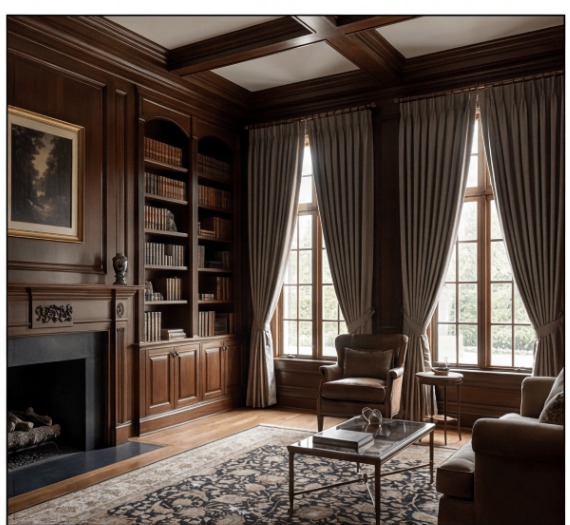
Goblet pleat is the heading that announces the room's formality from across the floor. The cuffed top is hand-stuffed with batting to hold its rounded shape, and the panel falls below in long, disciplined columns under crown molding and tall ceilings.
We specify goblet pleat sparingly. When the architecture asks for it — a Georgian dining room, a French Regency drawing room, a hand-painted library — nothing else will do. When the architecture does not ask for it, the heading reads as costume rather than as drapery.
Goblet pleat is most often paired with heavyweight silk, wool blend, or jacquard damask, lined and interlined for the body the heading needs to read correctly.
Where Goblet Pleat Drapery Belongs
- Formal dining rooms
- Formal drawing rooms
- Estate libraries
- Grand entry halls
- 10 ft.+ ceilings
- Crown-molded and coved rooms
- Gilded and hand-painted ceilings
- Traditional
- Georgian
- French Regency
- Italianate
- Estate-scale Mediterranean
Frequently Asked Questions
- What is the difference between goblet and cartridge pleat?
- They are the same heading. 'Goblet' describes the rounded, cuffed top; 'cartridge' describes the cylindrical shape it holds. Both terms refer to a hand-stuffed, batted heading.
- Is goblet pleat ever appropriate in a contemporary home?
- Almost never. The heading is decorative by definition; a contemporary room is usually asking for the opposite.
- Can goblet pleat drapery be motorized?
- Yes — on rod systems. We specify motor and heading together to confirm compatibility before fabrication.
Goblet Pleat Drapery Across Los Angeles
The studio works privately throughout Greater Los Angeles — measuring, fabricating, and installing goblet pleat drapery for residences in:
Consultations are also available throughout Calabasas, Hidden Hills, Hancock Park, Woodland Hills, and the surrounding foothill and coastal neighborhoods — see all studio service areas.
Goblet Pleat Drapery is documented across the studio archive. Recent installations include Beverly Hills Estate Window Treatments, Reseda Great Room Drapery, and Woodland Hills French Pleat Drapery. For the broader practice in this area, see custom drapery in Beverly Hills, and custom drapery in Bel Air. Pricing for projects of this scope is set out in the 2026 Custom Drapery Pricing Guide.