
- 20+ Years of Design Experience — Olga Rechdouni, ASID
- ASID Professional Member
- Custom Design · Fabrication · Installation
- Luxury Homes Throughout Los Angeles
Rod Pocket Drapery
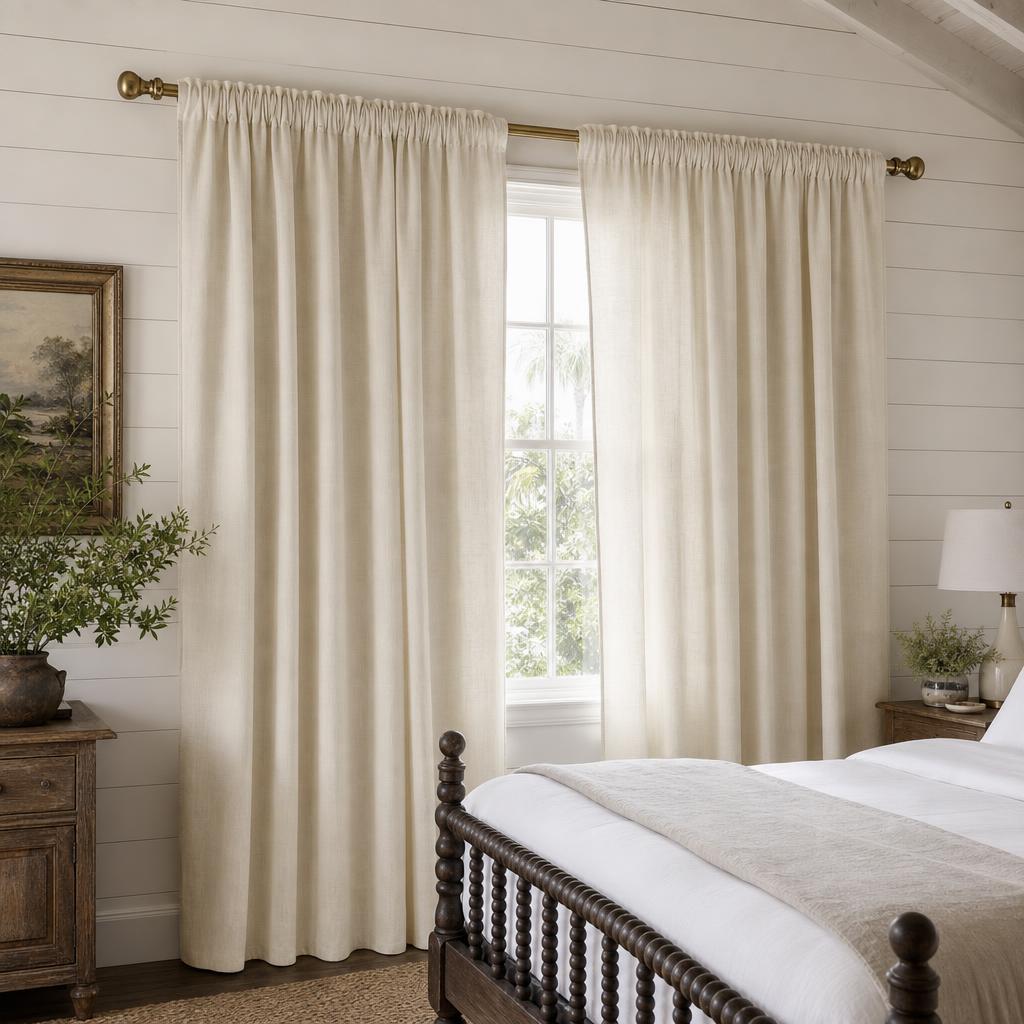
Rod pocket drapery is the most basic of all heading styles — a sewn channel at the top of the panel that slides directly over a decorative rod. The fabric gathers around the rod in soft, irregular folds, with no hand-tacked pleat and no carrier system. The studio specifies rod pocket only for sheer overlays and stationary side panels meant to read as decoration.
Why Choose This Style
Rod pocket is not a heading for primary drapery in a serious residence. It does not traverse cleanly, cannot be motorized, and reads as casual in any formal room.
Its most defensible specification is as a sheer overlay behind a hand-tacked French pleat — a layered system in which the rod-pocket sheer handles daylight and the over-drapery handles privacy and evening mood.
We also specify rod pocket for stationary cottage interiors, breakfast rooms with a single fixed panel, and powder rooms where the drapery is decorative rather than functional.
Where Rod Pocket Drapery Belongs
- Powder rooms
- Breakfast rooms
- Cottage bedrooms
- Stationary side panels
- 8–10 ft. standard ceilings
- Cottage
- Casual coastal
- Country French
- Traditional cottage
Frequently Asked Questions
- Why does the studio rarely specify rod pocket?
- It does not traverse cleanly, cannot be motorized, and reads as casual in any serious residence. Its appropriate uses are narrow.
- Can rod pocket be used as a sheer layer?
- Yes — this is its most defensible specification in a luxury home. A sheer rod-pocket overlay behind a hand-tacked French pleat is a legitimate layered system.
- Will rod pocket drapery slide easily?
- No. The fabric gathers tightly around the rod and resists traversing. Rod pocket panels are specified as stationary in the studio's work.
Rod Pocket Drapery Across Los Angeles
The studio works privately throughout Greater Los Angeles — measuring, fabricating, and installing rod pocket drapery for residences in:
Consultations are also available throughout Calabasas, Hidden Hills, Hancock Park, Woodland Hills, and the surrounding foothill and coastal neighborhoods — see all studio service areas.
Rod Pocket Drapery is documented across the studio archive. Recent installations include Malibu Ocean View Residence, and Porterville Living Room — Embellished Cornice Boxes, Sheers & Lined Drapery. For the broader practice in this area, see custom drapery in Malibu, and custom drapery in Pacific Palisades. Pricing for projects of this scope is set out in the 2026 Custom Drapery Pricing Guide.