
Why Your Window Treatment Designer Should Be Involved Before Construction
Coordinating the drapery design before drywall, ceiling pockets, and electrical are finalized — a working designer's guide to specifying motorized drapery during new construction and renovation.
One of the easiest ways to avoid expensive modifications later is to involve your window treatment designer early in the project. This is especially important during new construction and major renovations.
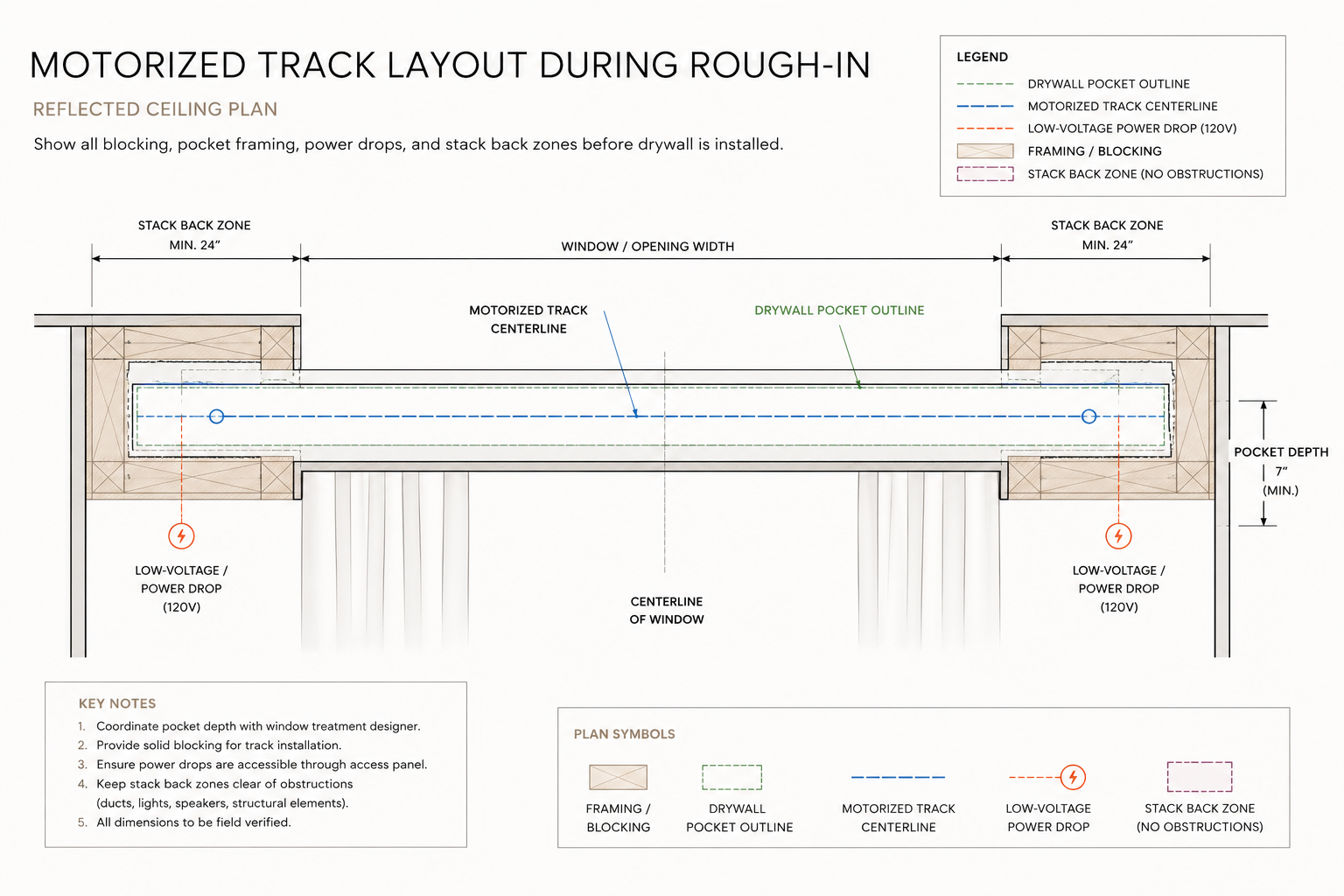
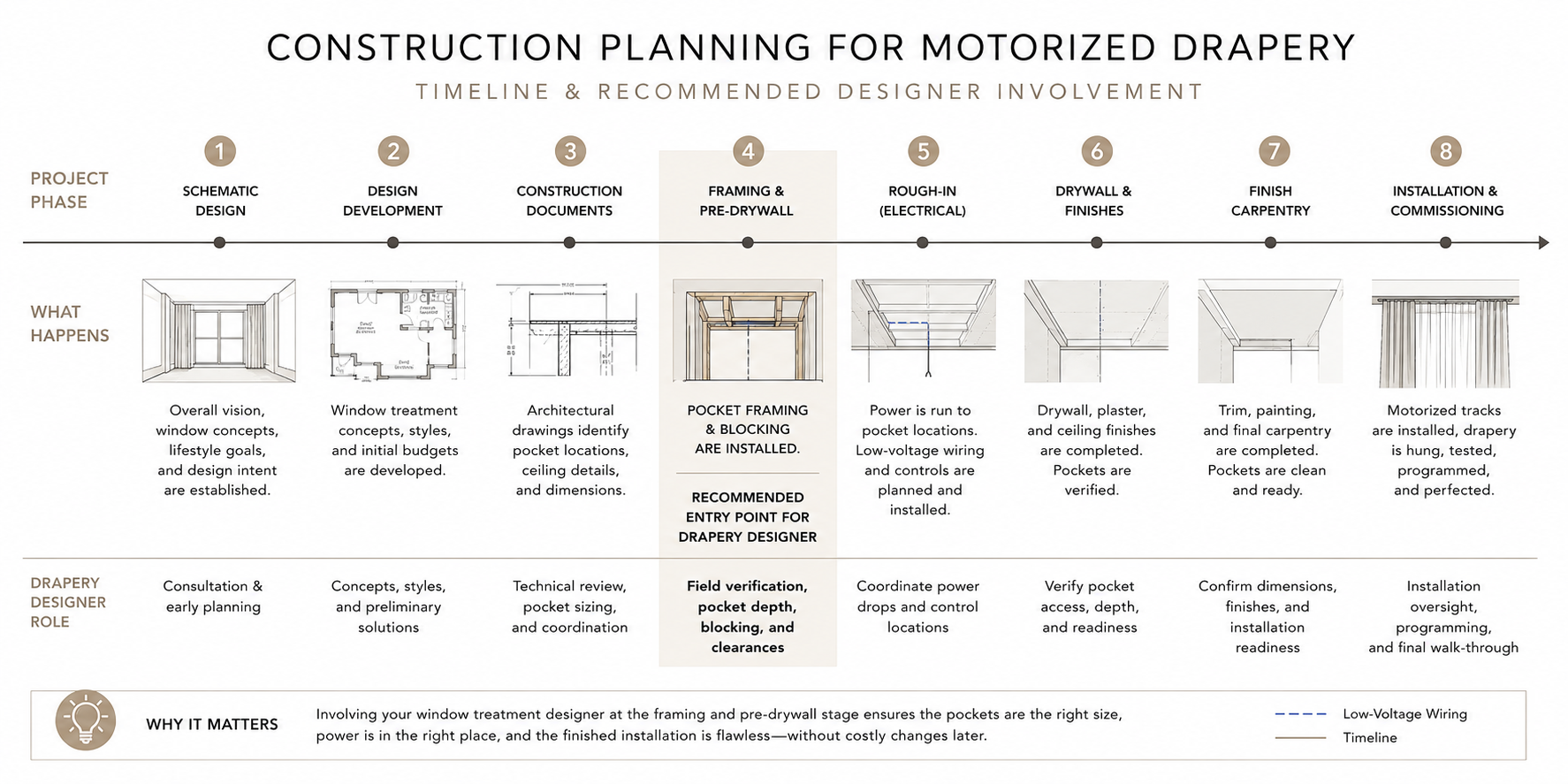
By the time drywall is installed, ceiling pockets have been framed, electrical wiring has been completed, and decorative ceiling details have been built, many of the critical decisions have already been made. If the window treatments haven't been designed yet, those construction details may no longer support the finished design.
That's why we recommend coordinating the window treatment design before construction reaches that stage. It allows the entire project team — including the homeowner, architect, interior designer, builder, electrician, and window treatment designer — to work toward the same solution from the beginning. The result is usually a cleaner installation, better performance, and fewer surprises.
What We Evaluate Before Recommending a Motorized System
Many homeowners assume that choosing a motorized system is simply selecting a brand. In reality, every recommendation begins with evaluating the complete project.
During a consultation we consider questions such as: How wide and how tall are the windows? Will the drapery be decorative, functional, or both? Will sheer drapery and decorative panels be layered together? Is blackout lining required for bedrooms or media rooms? How heavy will the finished drapery be? Which pleat style best complements the architecture? Will the motorized track be recessed into the ceiling or surface-mounted? Is the home already using a smart-home platform, or will the system operate independently? Would a hardwired motor or a rechargeable battery-powered motor be more appropriate? How much stack-back space is available when the drapery is fully open?
Every one of these decisions affects the final specification. That's why no responsible designer can accurately recommend a motorized system based on a photograph alone.
Lesson From the Field
One lesson we have learned after designing custom drapery for many different homes is that the window treatment should never be treated as the final finishing touch. It should be considered part of the architectural planning process.
The earlier we become involved, the more options homeowners usually have. We can recommend the appropriate ceiling pocket dimensions, evaluate whether the selected motorized track is suitable for the finished drapery, coordinate with the electrician if power is required, and help ensure that the finished installation functions as beautifully as it looks.
These conversations often take place long before the first fabric is selected. And that's exactly when they should happen.
Professional Recommendation
If you're planning motorized drapery, don't begin by shopping for a motor. Begin by designing the complete window treatment. The fabric, fullness, lining, pleat style, decorative hardware, motorized track, stack-back, installation method, and room architecture all work together as one system.
When those decisions are made together, the finished result is almost always better. That's true whether you're installing motorized drapery in a contemporary home in West Hollywood, a traditional residence in Pasadena, a coastal property in Newport Coast, or a luxury estate in Beverly Hills. Every home deserves a solution designed specifically for the way its owners live.
Frequently Asked Questions
Do I need a smart home to have motorized drapery? No. Many motorized drapery systems can operate independently using a remote control or wall control. Depending on the system and components selected, smartphone control and smart-home integration may also be available.
Which is better: Somfy or Lutron? Both are excellent manufacturers. The right choice depends on your project, budget, desired level of automation, and the overall window treatment design.
Can motorized drapery be installed in an existing home? Yes. Many existing homes can be fitted with motorized drapery. During a consultation, we evaluate the room, available power, installation conditions, and the best control options for your specific project.
Should the motorized track be installed before choosing the drapery? In most cases, the complete window treatment should be designed first. The finished fabric, pleat style, lining, fullness, and stack-back all influence the space required for a successful installation.
Complimentary Consultation
Every home is different. That's why we begin every motorized drapery project with a conversation rather than a product recommendation. Whether you're building a new home, remodeling an existing residence, or upgrading a single room, we'll help you understand your options before important construction or purchasing decisions are made.
At House of Drapery by Duroque, we provide complimentary consultations for homeowners throughout West Hollywood, Beverly Hills, Bel Air, Brentwood, Malibu, Santa Monica, Pasadena, Newport Coast, and communities across Los Angeles County. We'll evaluate your windows, discuss your design goals, explain the available motorized systems, and work with you — and, when appropriate, your architect, interior designer, or general contractor — to develop a solution that fits your home beautifully.
Our goal isn't simply to recommend a motorized track. Our goal is to design a window treatment that performs beautifully, integrates thoughtfully, and complements your home for years to come.
Olga Rechdouni is the principal designer of House of Drapery by Duroque and a consulting specialist on custom drapery for the residential interiors of Los Angeles. She is a member of the American Society of Interior Designers (ASID) and works privately with homeowners, interior designers, and architects.