
The Truth About Motorized Drapery: What Most Los Angeles Homeowners Don't Know Before They Buy
Why the first question is not which motor to buy, but which window treatment you are designing — a working designer's field guide to motorized drapery in Los Angeles.
Motorized drapery has become one of the most requested features in luxury homes throughout Los Angeles, West Hollywood, Beverly Hills, Bel Air, Brentwood, Malibu, Santa Monica, Newport Coast, Pasadena, and surrounding communities.
Yet despite its growing popularity, many homeowners begin with the wrong question.
Instead of asking, “What type of motor should I buy?” the first question should be, “What kind of window treatment am I designing?”
That may sound like a small difference, but it completely changes the outcome of the project.
After years of designing custom drapery and motorized window treatments throughout Los Angeles County, we have found that the most successful projects begin with the room — not the technology.
The Biggest Misconception About Motorized Drapery
One of the most common misconceptions we hear is: “Don't I need a smart home before I can have motorized drapery?” The answer is no.
Today's motorized drapery systems are far more flexible than many homeowners realize. Many systems can operate independently using a handheld remote or a wall-mounted control. Depending on the selected motor and control system, homeowners may also have the option to use a smartphone app or integrate their window treatments with compatible smart-home platforms.
Motorization doesn't require an entire smart-home ecosystem. For many homes, it can be a simple, standalone solution that adds convenience, comfort, and privacy.
Motorization Begins With Design — Not With the Motor
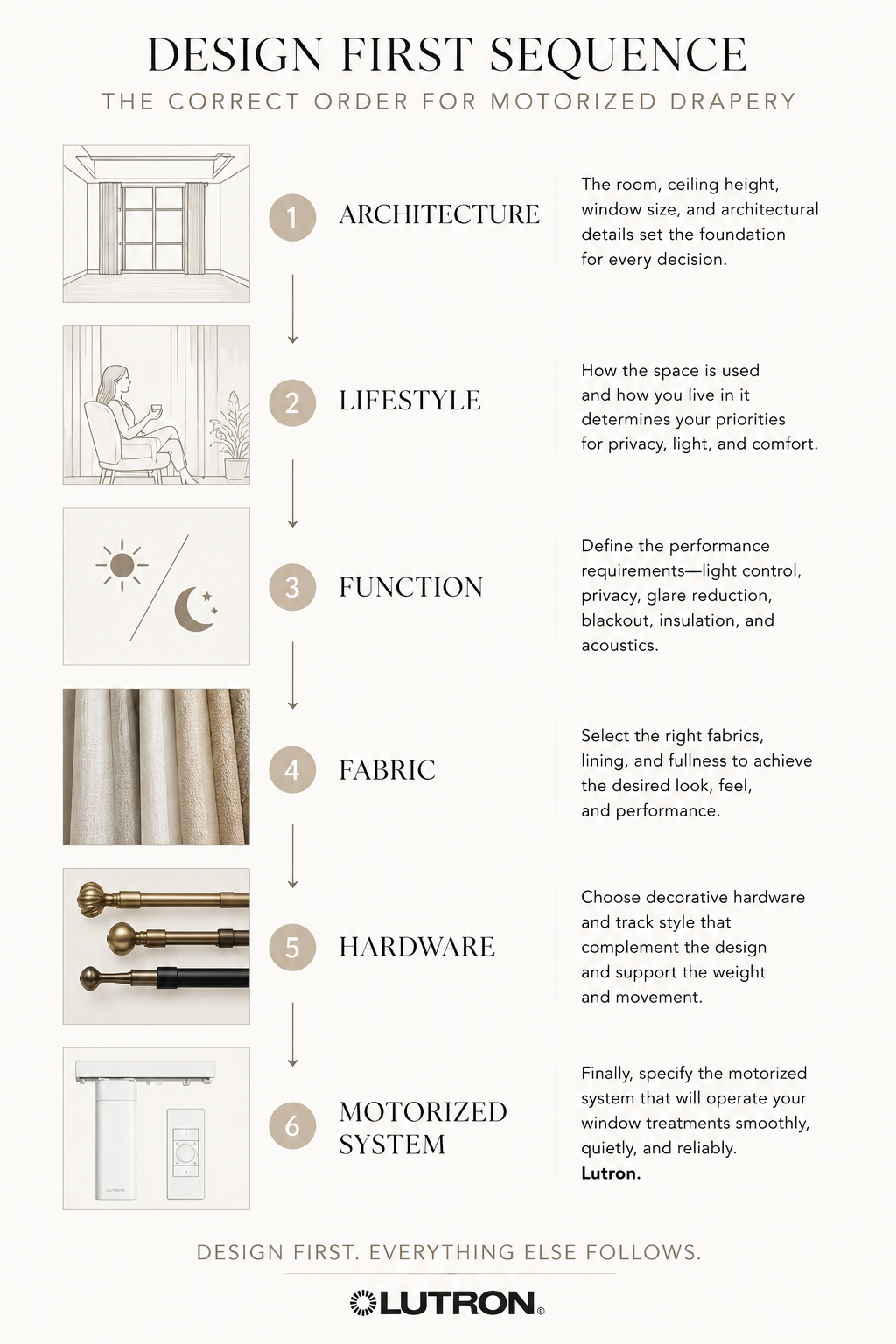
This is one of the most important concepts homeowners should understand. The motor is not the starting point. The window treatment is.
Before recommending a motorized system, we evaluate the room as a whole. We study the architecture, ceiling height, window dimensions, natural light, privacy requirements, furniture placement, how the room is used, desired level of light control, fabric selection, pleat style, lining, fullness, decorative hardware, and installation conditions.
Only after those decisions are made do we recommend the appropriate motorized system. The technology should support the design — not determine it.
Choosing Between Somfy and Lutron
One of the questions we are asked most often is: “Which is better — Somfy or Lutron?” The truth is that both manufacturers produce excellent motorized systems. The right choice depends on the project.
In many residential applications, Somfy offers an excellent balance of reliability, flexibility, and value. It has earned a strong reputation within the window treatment industry and is an excellent solution for many custom homes.
Lutron is widely recognized for premium integration and is frequently specified for larger residences and projects where motorized drapery is part of a comprehensive home automation system.
Rather than recommending one brand over another, we prefer to evaluate each project individually. Budget is certainly one factor, but it is never the only consideration. The size of the windows, the weight of the finished drapery, the desired controls, future automation plans, and the overall design all influence the final recommendation.
There is no universal “best” motor. There is only the motor that is best for your particular project.
A Motorized Track Should Never Be Chosen Before the Drapery Is Designed
This is probably the most valuable advice we can give homeowners. One of the most expensive mistakes we see doesn't involve the motor itself. It happens much earlier. Sometimes a motorized track is installed before anyone has designed the window treatments. That may sound logical, but it often creates unnecessary limitations later.
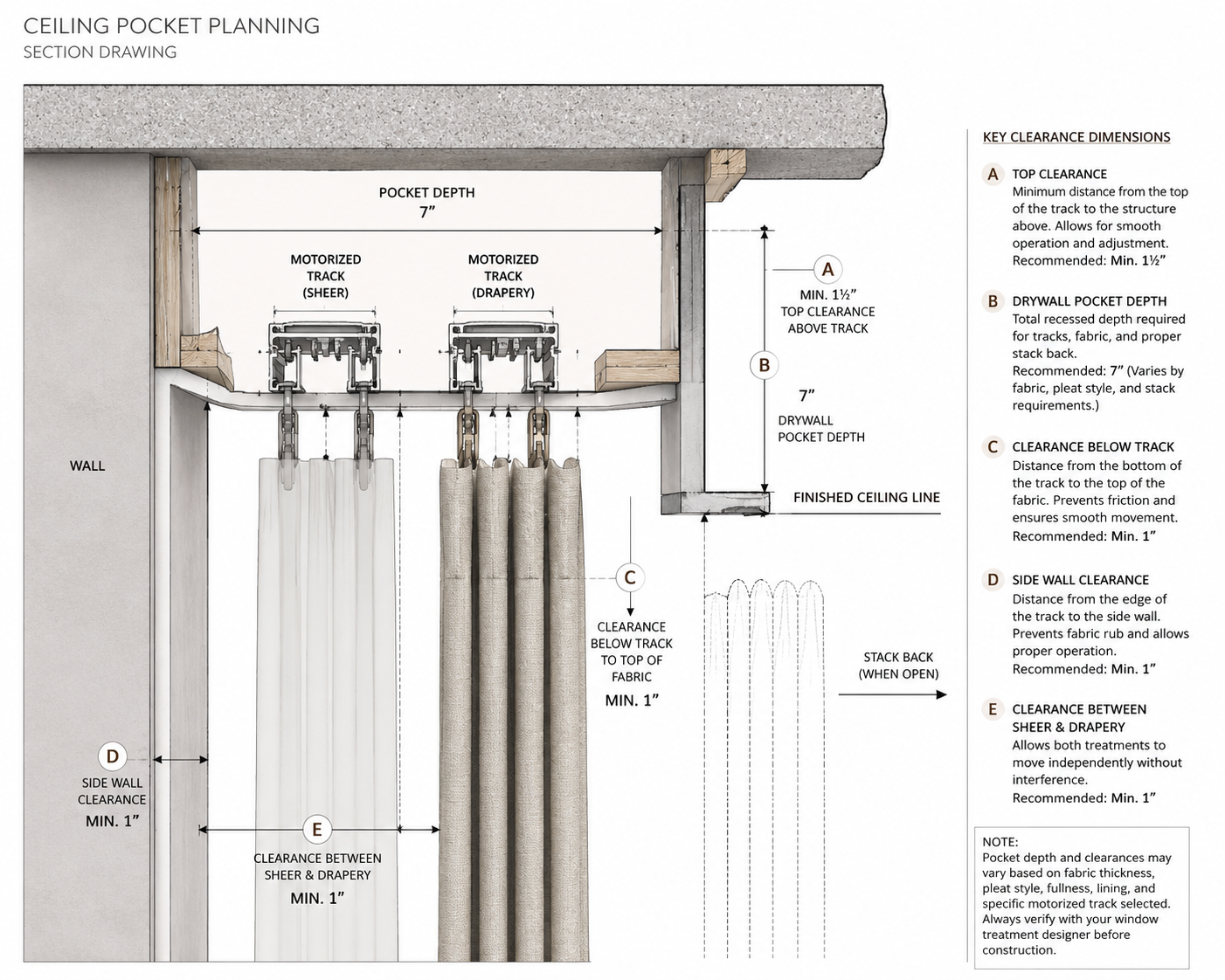
On one recent project, the motorized track had already been installed inside a recessed ceiling pocket that was only about four inches deep. Once we completed the window treatment design — including the fullness, lining, sheer fabric, decorative drapery fabric, and the homeowner's preferred pleat style — it became clear that the pocket simply wasn't deep enough to accommodate the original design.
Rather than rebuilding the ceiling pocket, we redesigned the drapery using a different pleat style that would perform properly within the available space. The project was successful, but it reinforced an important lesson: the size of the ceiling pocket should never be determined by the track alone. It should be determined by the complete window treatment.
Why Pocket Depth Matters
Many homeowners assume that if a motorized track fits inside a ceiling pocket, the drapery will fit as well. Unfortunately, that is not always true. The amount of space required depends on many factors, including the selected pleat style, the fullness of the drapery, the weight of the fabric, whether the drapery is lined or blackout-lined, whether decorative sheers will be installed behind the decorative panels, stack-back requirements, decorative returns, and the motorized track itself.
A lightweight sheer requires different clearances than a heavily lined velvet drapery. A French pleat requires different space than an inverted pleat. Ripple Fold systems have different stacking characteristics than traditional pinch pleats.
These are details that should be considered before construction is complete — not afterward.
Designer Tip
Motorized drapery should never be specified independently from the window treatment itself. The fabric, lining, fullness, pleat style, stack-back, hardware, and installation conditions all influence which motorized system will perform best. Designing the complete solution first can help avoid unnecessary compromises later.
Olga Rechdouni is the principal designer of House of Drapery by Duroque and a consulting specialist on custom drapery for the residential interiors of Los Angeles. She is a member of the American Society of Interior Designers (ASID) and works privately with homeowners, interior designers, and architects.